
The Marble Wing · Ancient Greeks
Epicureanism
A man asked for a pot of cheese and called it a feast. They put him in Hell for it.
Epicurus died in agony and called it "a happy day" — because fifty years of friendship, cheese, and conversation outweighed the worst pain a body can produce. History's most slandered philosopher proved that pleasure peaks not in luxury but in the absence of wanting more.
In 5 minutes
Epicureanism says a happy life comes from simple pleasures, good friends and freedom from fear, not from luxury.
- The best pleasure is calm: no pain in the body and no worry in the mind.
- Friendship is one of the greatest goods a person can have.
- Death is nothing to fear, because when death is here, we are not.
Try today: Eat one simple meal slowly, with no screen, and notice how much pleasure a little food gives.
Before you go in…
One small question at the door. No right answers, just yours, and then how Epicureanism would reason about it.
You're refreshing a sale page at midnight for an upgrade you didn't know existed last week. Which kind of desire is this, really?
A Happy Day to Die#
Athens, 270 BC. An old man is dying badly.
Kidney stones have sealed his urinary tract shut. He hasn't peed in days. Dysentery is tearing through his gut simultaneously — his body trying to expel everything through the only exit left. If you've ever had a kidney stone, you know that pain ranks alongside childbirth and gunshot wounds. Now imagine that pain plus severe dysentery, plus being 72 years old in a world without painkillers.
This man picks up a pen. He writes to his friend Idomeneus:
"I have written this letter to you on a happy day to me, which is also the last day of my life. For I have been attacked by a painful inability to urinate, and also dysentery, so violent that nothing can be added to the violence of my sufferings. But the cheerfulness of my mind, which comes from the recollection of all my philosophical contemplation, counterbalances all these afflictions."
A happy day. Read that again, slower. His organs are failing, his body is a torture chamber, and the man calls it a happy day.
This isn't Stoic jaw-clenching. Marcus Aurelius would have told you to endure the pain because that's what a good Roman does. This isn't religious faith in a paradise waiting on the other side. This man didn't believe in an afterlife.
This is something stranger and more interesting. This is a man who spent fifty years building a life so rich in friendship, so steeped in small daily pleasures, so thoroughly thought through, that the accumulated weight of all that joy could sit on one side of a scale and hold its own against the worst physical agony a human body can produce.
His name was Epicurus. And his reward for all of this? Two thousand years of being called a glutton, a hedonist, a pig. Dante shoved him into the sixth circle of Hell. The word "epicurean" became a synonym for someone who needs the most expensive thing on the menu.
The real Epicurus asked for a pot of cheese and called it a feast.
The gap between the man and his reputation is one of the greatest slanders in intellectual history — and understanding why it happened tells you more about what humans are afraid of than any psychology textbook.
The Misconception That Won't Die#
Here's what most people think Epicureanism means: life is short, so eat the fancy dinner, book the first-class ticket, drink the good wine. Pleasure is the point. Indulge yourself. YOLO with a philosophy degree.
This is roughly as accurate as thinking Nietzsche was a Nazi, or that meditation is about clearing your mind, or that Darwin said we descended from monkeys. It's not just wrong — it's wrong in a way that perfectly inverts the actual idea.
Epicurus said pleasure is the highest good. That part's true. But his definition of pleasure would get him laughed out of any Vegas hotel.
He divided pleasure into two kinds. The first is kinetic pleasure — the active buzz of satisfying a craving. Biting into a meal when you're starving. Cold water after a run. The rush of getting.
The second is katastematic pleasure — the quiet hum of already having enough. Not hungry. Not thirsty. Not afraid. Not in pain. Just... okay. Content. That warm, settled feeling when you're lying on the couch after dinner with a friend, full but not stuffed, talking about nothing in particular, and you realize you don't want to be anywhere else.
Epicurus said the second kind is better. Way better. And that everything goes wrong when you mistake the first kind for the goal.
Think about it like this: social media is a kinetic pleasure machine. Every notification is a tiny hit — someone liked your post, someone replied, someone followed you. Buzz, buzz, buzz. But no amount of notifications ever produces that warm settled feeling. You close Instagram and feel worse. That's because kinetic pleasures are like saltwater — they seem like they'll quench your thirst but they actually make it worse.
Katastematic pleasure is what you feel when you put the phone in a drawer and don't think about it for three hours. It's the absence of craving. It's being free from the itch.
Epicurus had a word for the mental version of this: ataraxia. Freedom from disturbance. Not bliss. Not excitement. Undisturbedness. The mind at rest, like a lake with no wind on it.
If that sounds like what meditation people are always going on about, you're not wrong. Epicurus beat them to it by about 2,300 years.
A Garden in a World on Fire#
Epicurus didn't come up with this philosophy while lounging in comfort. He forged it in chaos.
Born on the island of Samos in 341 BC, he was the son of a schoolteacher — respectable, not wealthy, definitely not aristocratic. His enemies later claimed his mother went door-to-door doing folk purification rites, which was their way of saying this guy is low-class trash. (Philosophy in ancient Athens had the same class snobbery as Ivy League admissions. Plato came from one of the richest families in the city. Epicurus did not.)
He was seven when Alexander the Great marched east to conquer everything. Eighteen when Alexander died and the empire fractured into warring successor states. Somewhere in those chaotic years, one of Alexander's generals expelled all the Athenian settlers from Samos, and Epicurus's family became refugees — scattered to the Turkish coast, everything they knew ripped away.
So when Epicurus later said that tranquility is the highest good, he wasn't a trust-fund kid philosophizing about calmness from inside a spa. He was a displaced person who'd watched the political order collapse, seen his family uprooted, and decided to figure out what couldn't be taken from you.
Around 306 BC, he did something that looked minor but was quietly revolutionary. He bought a garden in Athens.
Not a gymnasium. Not a lecture hall. A garden. And the location was deliberate — planted right between Plato's Academy and the Stoa, the two prestigious schools where rich men's sons learned philosophy as a path to political power.
Epicurus's garden was different. He let everyone in.
Women studied there. In a world where Aristotle — Aristotle — had written that women were basically defective men, Epicurus taught women philosophy. One of them, Leontion, became so accomplished that she published a treatise ripping apart Theophrastus, the head of Aristotle's Lyceum. Cicero grudgingly admitted her writing had "Attic elegance," which was Roman for she's brilliant, and I hate that.
Enslaved people were welcomed. In a society that considered slavery as natural as weather, the Garden said: sit down, eat with us, let's talk about the nature of the universe.
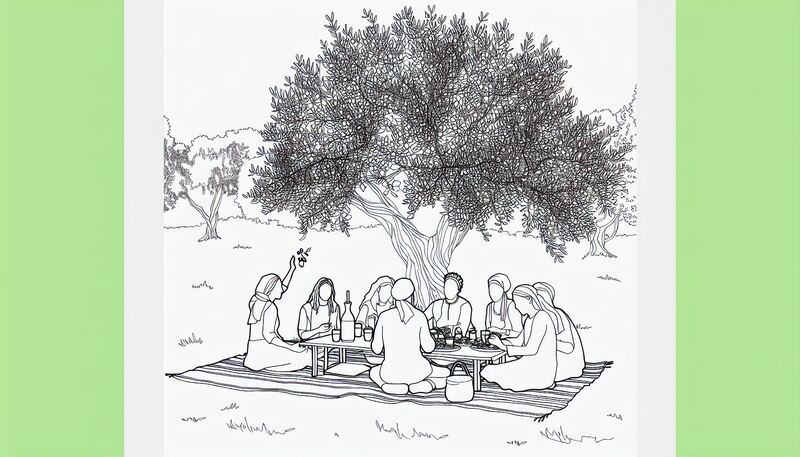
And what did they eat? Bread. Cheese. Water. Sometimes a little wine. That was the community that scandalized Athens. That was the "hedonist" commune that horrified the establishment for centuries. A bunch of people from every level of society, eating bread and cheese in a garden, talking about atoms and friendship and how to die well.
Try this, right now: Think about the last meal you ate with a friend where you actually talked about something real. Not networking. Not small talk. A conversation that mattered. How long ago was it? If the answer depresses you, that's Epicurus tapping you on the shoulder.
The Four-Part Cure#
Epicurus was suspicious of complicated philosophies. He thought if your worldview couldn't fit on an index card, you probably didn't understand it well enough. So he boiled the whole thing down to four lines — the tetrapharmakos, the "four-part remedy":
Don't fear god. Don't worry about death. What is good is easy to get. What is terrible is easy to endure.
The name comes from a wound salve made of four ingredients — wax, tallow, pitch, and resin. Philosophy as medicine. Not as intellectual decoration, not as dinner party conversation, but as something you apply to the wound.
"Vain is the word of a philosopher which does not heal any suffering of man," Epicurus wrote. "For just as there is no profit in medicine if it does not expel the diseases of the body, so there is no profit in philosophy either, if it does not expel the suffering of the mind."
If your philosophy doesn't help you at 3 AM when you can't sleep, it's not a philosophy. It's a hobby.
Here's what each line actually means:
Don't fear god. Epicurus wasn't an atheist — he thought gods existed, but as perfectly blissful beings who couldn't care less about humans. His target was superstitious terror. In 300 BC, people genuinely believed earthquakes were divine punishment. Epicurus said: no. That's atoms moving through void. The universe isn't watching you. The earthquake isn't personal.
This was, twenty-three centuries before modern science, an astonishingly modern position. And for people living under the constant psychic weight of divine surveillance — every bad thing that happens is because god is mad at you — it must have felt like someone cracking a window in a room that had been sealed for years.
Sound familiar? Swap "the gods are angry" for "the universe is testing me" or "everything happens for a reason" or the vague cosmic guilt people carry when things go wrong, and you've got the modern version of the same anxiety. Epicurus's answer is the same: the universe doesn't have opinions about you. Relax.
Don't worry about death. This is his most famous argument, and it's still one of the most elegant pieces of reasoning anyone's ever produced:
You will never experience your own death. While you exist, death doesn't. When death arrives, you don't. The state after your death is identical to the state before your birth — and you don't spend any time agonizing over the 13.8 billion years you missed before you showed up.
He called this the Symmetry Argument. The abyss after you is the same as the abyss before you. You've already been dead for an eternity. It wasn't so bad.
This doesn't mean grief is irrational or that death doesn't matter. It means the anticipation of your own non-existence — that cold dread at 2 AM — is a fear of something you'll literally never feel. You're burning real present-tense hours worrying about an experience that is, by definition, impossible.
What is good is easy to get. The most counterintuitive line, and the one that matters most. Epicurus is claiming that the things you actually need to be happy — not the things Instagram tells you to need, not the things your coworkers are competing for, but the things your nervous system genuinely requires to feel at peace — are shockingly simple. Bread. Water. Shelter. Friends.
"Send me a pot of cheese, so that I may have a feast when I like."
That's a real quote. That's the man they called a glutton. A pot of cheese = a feast. Let that land.
He split desires into three buckets:
Natural and necessary — food, water, shelter, friendship. Easy to satisfy, and satisfaction actually sticks.
Natural but unnecessary — fancy food, a nice apartment, comfort. Fine to enjoy, but you're not broken without them.
Unnatural and unnecessary — fame, political power, extreme wealth, the approval of strangers. These are bottomless. You can pour your entire life into them and never feel full.
Here's the killer insight: most of modern capitalism runs on convincing you that things in the third bucket are actually in the first. That you need the upgrade, the followers, the promotion, the bigger house. Every ad you've ever seen is an attempt to reclassify a luxury as a necessity. Epicurus would look at your phone's notification center and see a machine specifically designed to manufacture artificial dissatisfaction.
Try this today: Next time you want something — a purchase, an achievement, whatever — ask yourself: which bucket? Natural and necessary? Natural but unnecessary? Or am I being played? You don't have to stop wanting it. Just see which category it actually falls into. That clarity alone changes something.
What is terrible is easy to endure. This is the line that sounds naive until you test it. Epicurus's claim: severe pain is usually brief, and chronic pain is usually mild. The overlap — severe and prolonged — is rare.
He's not dismissing suffering. He's making an empirical observation and pairing it with a psychological one: we suffer more from the anticipation of pain than from pain itself. The dentist appointment is worse in your head for the three days before than in the chair for the twenty minutes during. The breakup you're dreading is worse in the projecting than in the living through.
And then there's his deathbed letter. The proof of concept. The man in the worst pain of his life, writing a happy day, because decades of friendship and contemplation had built a counterweight heavy enough to balance it.
The People in the Garden#
Philosophy is usually a solo act — one genius, alone with their thoughts, producing manuscripts. Epicurus's greatest invention wasn't a manuscript. It was a community. And the stories from that community are what make Epicureanism more than an idea.
Metrodorus was Epicurus's closest friend. They met when Epicurus was teaching in Lampsacus and became inseparable — not as master and disciple, but as something closer to what we'd now call a life partner in friendship. When Metrodorus died around 277 BC, Epicurus established a permanent monthly feast in his memory. And his final letter — the one written in agony on his deathbed — ends with this: "I beg you to take care of the children of Metrodorus."
His last written words on Earth weren't about his pain, his legacy, or his philosophy. They were about his dead friend's kids. That tells you everything.
Leontion was a hetaira — a companion, which the Garden's enemies used as ammunition to discredit her. She became a philosopher who took on the most powerful intellectual in Athens. Her critique of Theophrastus was apparently so sharp that even people who hated Epicureans had to admit it was well-written. A woman, in 300 BC Athens, publishing philosophy and picking public fights with the head of the Lyceum. The Garden made that possible.
Diogenes of Oenoanda, four centuries later, proved the philosophy's staying power. This wealthy Epicurean in a small Turkish town, old and dying, commissioned an 80-meter stone wall inscribed with Epicurus's teachings so that passersby — any passerby, from any country — could read them. His inscription includes this:
"While the various segments of the Earth give different people a different country, the whole compass of this world gives all people a single country, the entire Earth, and a single home, the world."
A man in a provincial Turkish town in the second century AD, carving universal human kinship into a wall. Epicureanism did that to people. It made them want to leave something generous behind.
The Swerve#
One of Epicurus's weirdest and most brilliant ideas almost never makes it into the popular accounts, and it should, because it's wild.
He inherited his physics from Democritus: everything is atoms and void. No gods pulling strings, no cosmic plan, just tiny particles bouncing around in empty space. Clean and elegant — but there's a problem. If atoms follow strict mechanical laws, then everything is predetermined. Including your thoughts. Including your decision to read this sentence. You're not choosing anything. You're just dominoes falling.
Epicurus couldn't accept this. So he introduced the clinamen — the swerve. At random, unpredictable intervals, atoms deviate slightly from their expected path. Just a tiny wobble. Barely anything.
But that wobble is enough. It breaks the chain of determinism. It means the future isn't written. It means you have genuine choices. Lucretius, the Roman poet who turned Epicureanism into one of the greatest poems ever written, said the swerve "breaks the bonds of fate."
Is this scientifically rigorous? Not really. Is it philosophically brilliant? Absolutely. Epicurus essentially argued that randomness is woven into the fabric of reality — that the universe has a built-in escape hatch from pure mechanism. He said this twenty-three centuries before quantum mechanics arrived at something weirdly similar.
The swerve is also a beautiful metaphor for how Epicureanism works. You're rolling along — consuming, competing, anxious, on the treadmill — and then something shifts. Some tiny deviation. You read something, or a friend says something, or you're sitting alone one evening and you suddenly see the treadmill for what it is. And you step off. Just slightly. Just a swerve. But everything changes after that.
What They Did to Him (And Why)#
Here's a question that's worth sitting with: why did they slander him so badly?
Epicurus lived modestly, taught generosity, welcomed outcasts, and died peacefully. His community practiced shared meals, mutual care, and philosophical conversation. By any reasonable standard, he was a good man running a good community.
And they hated him for it.
The Stoics went after him first. Epictetus called Epicureans "effeminate." It was a philosophical turf war — the Stoics believed virtue was the only good, and any philosophy that said pleasure (even redefined pleasure) was the highest good was a threat to that brand.
Then the Christians arrived, and it got worse. A philosophy that said: the gods don't care about you, death is nothing, the universe is atoms and void, and pleasure is the goal? That's a direct contradiction of nearly every Christian doctrine. The soul, divine judgment, the afterlife, the value of suffering — Epicurus denied all of it.
So they didn't just disagree with him. They erased him. Of the 300+ works Epicurus wrote, almost nothing survived. Not because the manuscripts crumbled naturally, but because nobody bothered to copy them. In a world where monks were the photocopiers, being on the Church's bad list meant your words died when the papyrus did.
The irony is brutal. The philosophy that said "what is terrible is easy to endure" was made to endure one of the most terrible fates a thinker can face: being remembered as the opposite of what you were.
Epicurus was a man who ate bread and cheese and said friendship matters more than anything. They turned him into the patron saint of excess. Because — and this is the part that matters — any philosophy that gives you permission to enjoy your life will always be threatening to systems that need you to feel guilty.
The distortion isn't a historical accident. It's a tell. It tells you which ideas the powerful find most dangerous.
The Quiet Renaissance#
Epicureanism is having a moment, and almost nobody's talking about it.
Not in philosophy departments — those are still Stoicism's territory, thanks largely to Ryan Holiday and the Silicon Valley crowd. But in the actual lives of actual people, something Epicurean is happening.
The FIRE movement (Financial Independence, Retire Early) is Epicureanism in a spreadsheet. The core insight — that freedom comes from wanting less, not earning more — is pure tetrapharmakos, third line.
The minimalism wave is the Garden with better furniture. Marie Kondo asking "does this spark joy?" is katastematic pleasure in a Netflix series.
The loneliness epidemic that sociologists keep writing alarmed op-eds about? Epicurus would call it what it is: a philosophical emergency. Not a social inconvenience. A civilization-level failure to prioritize the one thing that actually makes humans happy.
A Reddit user on r/Epicureanism put it perfectly:
"I've been interested in Stoic philosophy for a long time and read Meditations, Seneca, etc., but recently I've come to the realization that Epicureanism is just way more... human? Good friendships, happy moments, and even simple things like going for a walk, watching the sunrise, and being grateful for what I have."
That word — human — keeps coming up when people discover Epicureanism. It's the philosophy that doesn't ask you to be a superhero. Stoicism says: endure everything, control your emotions, be an unshakable fortress. Buddhism says: detach from desire entirely. Epicureanism says: you're a human animal with a body that likes bread and a heart that needs friends. Start there.
There's something almost subversive about that gentleness. In a culture that worships hustle and optimization and 5 AM cold plunges, a 2,300-year-old man saying "a pot of cheese is a feast" is the most countercultural thing you could hear.
The Epicurean Inversion#
Here's the move that makes Epicureanism genuinely different from every other self-help framework.
Most systems say: get more of the good stuff. Work harder, earn more, achieve more, experience more. The hedonic treadmill goes faster, but surely if you run fast enough...
Stoicism says: want less, but through discipline and willpower. Force yourself to not care about externals. White-knuckle your way to tranquility.
Epicureanism says something sneakier. It says: look more carefully at what you already have. Not through forced gratitude journaling. Not through willpower. Through understanding. Once you genuinely understand that bread and friendship and a clear mind are the raw materials of a good life — once that stops being a nice idea and becomes something you actually see — the craving for more quiets down on its own. Not because you suppressed it, but because you stopped being confused about what you needed.
It's the difference between a diet and losing your appetite for junk food. The first is willpower. The second is a shift in perception. Epicurus is after the second one.
"Do not spoil what you have by desiring what you have not; remember that what you now have was once among the things you only hoped for."
Think about the apartment you live in, the job you have, the phone in your hand. There was a time when each of these was the thing you were working toward, daydreaming about, hoping for. And now you have them and you barely notice because you're already reaching for the next thing.
That's the treadmill. Epicurus's move is absurdly simple: notice that you're on it. Not once, as an insight, but repeatedly, as a practice. Every time you catch yourself reaching for the next thing, look down at your hands. They're full.
Try this at your next meal: Before you eat, pause for three seconds. Not to pray. Not to do a gratitude exercise. Just to register that you have food in front of you, that your body works, that you're about to experience the simple animal pleasure of eating. That's it. Three seconds of actually being where you are. Epicurus would call this the difference between consuming and feasting.
How to Build a Garden#
The Garden wasn't a building. It was an agreement between people: let's figure out how to live well, together.
You can build one. Here's what it actually looks like in practice:
Find your Metrodorus. Not a networking connection. Not a gym buddy. A friend you can talk to about what scares you, what you're hoping for, what you wonder about when you can't sleep. If you don't have this person, finding them is the most important project you could undertake. More important than any career goal, any fitness goal, any financial goal. Epicurus was unequivocal: "Of all the means which wisdom acquires to ensure happiness throughout the whole of life, by far the most important is friendship."
Hold your Eikas. On the twentieth of every month, Epicureans gathered for a shared meal and conversation. Start this. Invite people over. Cook something simple — the food is not the point. Talk about ideas, about life, about what you've been thinking about. Make it recurring. The recurrence is what transforms a dinner party into a practice.
Audit your desires regularly. Not once, as a self-help exercise you check off and forget. Monthly. What am I chasing right now? Which bucket is it in? Natural and necessary? Natural but unnecessary? Or am I being sold something? This isn't about deprivation. It's about clarity. You can still want the nice thing. You just want to know why you want it.
Study the world. Epicurus thought understanding nature was a source of pleasure, not just knowledge. When you understand how lightning works, storms become beautiful instead of terrifying. When you understand how your brain manufactures anxiety, the 3 AM spiral loses some of its power. Read science. Watch documentaries. Be curious. Curiosity is an Epicurean virtue.
Practice the symmetry argument. When death-anxiety hits — and it will, because you're a conscious animal and conscious animals get spooked by the dark — remind yourself: the 13.8 billion years before you were born were fine. The years after will be the same. What you have is now. This conversation. This meal. This evening light. Don't waste it rehearsing an experience you'll never have.
What Survives#
Of the 300+ works Epicurus wrote, we have fragments. Three letters. Forty maxims. Some scattered sayings. The charred remains of scrolls pulled from a villa in Herculaneum, buried under volcanic ash for two thousand years, still being unrolled and deciphered right now using AI and X-ray technology. (There's a poetry to that — a philosophy of atoms and void, nearly destroyed by a volcano's atoms, being resurrected by machines that process information in patterns Epicurus would have recognized as atomic.)
But here's what actually survived: the idea. Through Lucretius, who turned Epicureanism into a 7,400-line Latin poem so beautiful that it kept the philosophy alive through sheer literary force. Through Poggio Bracciolini, a papal secretary who found a copy of that poem in a German monastery in 1417 and brought it back into circulation, helping spark the Renaissance. Through Thomas Jefferson, who called himself an Epicurean. Through every person who's ever sat with a friend over a simple meal and felt the specific, irreplaceable warmth of this is enough.
If you want to go deeper: Start with the Letter to Menoeceus — 1,500 words, shorter than most blog posts, the closest thing to an Epicurean manifesto. Read Lucretius's On the Nature of Things in the A.E. Stallings verse translation, which is so good it makes you angry that more people haven't read it. Read Stephen Greenblatt's The Swerve for the detective story of how Lucretius's poem was lost and found. Read Catherine Wilson's How to Be an Epicurean for a modern philosopher's take on what this looks like in the twenty-first century.
Or don't read any of them. Just have dinner with a friend this week. Cook something simple. Talk about something real. Notice how it feels — not the food, but the being-together. Notice the specific quality of that pleasure. The warmth that isn't excitement. The fullness that isn't about the meal.
That's the Garden. It was never about the garden.
Epicurus died on a happy day. Not because he was brave, not because he was performing, not because he believed something better was waiting. He died happy because he'd spent fifty years paying attention to the right things — bread, cheese, friendship, conversation, the feel of sunlight, the sound of someone you love laughing in the next room. He died happy because he'd figured out something that most of us spend our entire lives missing: that the feast was always already here.
You just have to stop reaching long enough to notice.
Talk about it · 4 questions
- Why do you think Epicurus was called a lover of luxury when he lived so simply?
- Epicurus sorted desires into natural and unnecessary ones. Which of your wants are which?
- Is it possible to be happy while in pain? What did Epicurus think?
- Does the argument "where death is, I am not" remove the fear of death for you?