
The Marble Wing · Ancient Greeks
Pyrrhonism
The most honest philosophy ever created started with a pig in a storm
A ship is sinking, passengers are screaming, and a pig eats from its trough unbothered — because it hasn't decided the situation is unbearable yet. Pyrrho pointed at the pig and said: that's wisdom. Twenty-three centuries of epistemic humility followed.
In 5 minutes
Pyrrhonism says we can rarely be sure what is true, and that holding back judgement can bring peace of mind.
- For almost every argument there is an equally strong argument on the other side.
- Suspending judgement (epoché) is honest, not lazy.
- Peace of mind often comes when we stop insisting we must be right.
Try today: Choose one strong opinion you hold. Write the best argument against it in two or three sentences.
Before you go in…
One small question at the door. No right answers, just yours, and then how Pyrrhonism would reason about it.
Two sharp, well-sourced articles in your feed reach opposite conclusions about something you care about. You can't check it yourself. What do you do with your opinion?
The most honest philosophy ever created didn't start with an answer. It started with a pig.
There's a ship in a storm. Passengers screaming, white-knuckling the rails, absolutely certain they're about to die. And in the corner—a pig. Eating from its trough. Couldn't care less about the waves.
A philosopher named Pyrrho points at the pig and says: That. That's what wisdom looks like.
Not courage. Not faith. Not "everything happens for a reason." Just—no opinion about the storm. No story about what it means. No frantic calculation of odds. Just a creature standing in raw experience, unbothered, because it hasn't decided yet that the situation is unbearable.
Twenty-three centuries later, you're on a different kind of ship. You're scrolling Twitter at 1 a.m. and every single person on your feed is 100% sure about something. The economy. The election. Whether that movie was good. They've all got their positions locked in, their tribes chosen, their certainty polished to a shine. And you're sitting there with this quiet, gnawing feeling: What if I don't actually know?
Pyrrhonism says: that feeling is not weakness. That feeling is the beginning of freedom.
A Painter Who Couldn't Stop Asking Questions#
Before Pyrrho became the godfather of Western skepticism, he painted things. Walls, probably. He wasn't famous. He came from Elis, a little town in the Greek Peloponnese mostly known for hosting the Olympics. His family, the Klytidiai, were oracle interpreters at the Temple of Zeus—professional readers of goat entrails and smoke patterns.
Think about that for a second. He grew up watching people beg for certainty. Will I win the war? Will she love me? Will the harvest come? And he watched the oracles deliver answers vague enough to mean anything. "A great empire will fall." Sure. Whose empire? That part's on you.
If you spent your childhood watching that racket, you might start to wonder about the whole enterprise of confident knowledge.
Pyrrho ditched painting and picked up philosophy. Studied under a guy named Anaxarchus, who came from the Democritean tradition—the school that said everything is atoms and void, and what we call "sweet" or "bitter" or "beautiful" is just convention. Anaxarchus called reality a "scene-painting": looks solid from the cheap seats, but walk up close and it's canvas and pigment.
That was Pyrrho's intellectual soil. Already loose. Already shifting under his feet.
But what turned him into Pyrrho was a war.
The Road to the Wandering Sages#
In 334 BCE, Alexander the Great launched his campaign to conquer everything east of breakfast. His army wasn't just soldiers—he brought scientists, mapmakers, philosophers. A traveling university with swords. Anaxarchus tagged along. Pyrrho came too.
For a decade, Pyrrho marched. Through Persia. Through what's now Afghanistan. And then, around 326 BCE, into India—further than any Greek had ever gone.
And in India, he met the Gymnosophists.
That's Greek for "wandering sages." They were probably Jain monks, or Hindu ascetics, or maybe Buddhist practitioners. Nobody's sure. Scholars have been arguing about it for centuries, which is sort of perfect for a story about skepticism. One ancient source says that conversations with them required three translators, none of whom understood any philosophy. It was, quote, "like asking water to flow through mud."
But something got through.
Maybe it was watching a man stand motionless in the sun for hours, owning nothing, needing nothing, holding no position about anything. Maybe it was encountering an entire tradition—the Ajñana, the ancient Indian agnostics—who refused to make philosophical claims at all. Who simply said: I don't know, and I'm fine.
Try this right now. Think of the last argument you got into—online, in your head, with a partner. Think of how tightly you gripped your position. Now imagine someone who looked at both sides of that argument and genuinely said, "I don't know which is right." Feel the physical sensation in your chest. That loosening. That's what Pyrrho brought back from India.
Whatever he saw there, the man who returned to Greece wasn't the man who'd left. He'd found something the Greek philosophers—with their endless systems and confident declarations about the nature of reality—hadn't found.
He'd found the peace that lives on the other side of "I don't know."
The Three Questions That Ruin Everything Comfortable#
Pyrrho didn't write anything down. (Of course he didn't.) What we know comes through a chain of people who knew people who knew people who talked to his student Timon. The telephone game of ancient philosophy. But the core survives, organized around three questions:
One: What are things actually like?
Pyrrho's answer: we can't say. Things are equally indifferent, unstable, indeterminate. Our senses don't deliver truth, and our opinions don't either. They're not lying to us—they're just not qualified to make the call.
Two: So how should we relate to things?
Without opinions. Without leaning. Saying of every single thing: "It no more is than is not, or both is and is not, or neither is nor is not."
(Yeah. Read that again. Let it break your brain a little. That's the point.)
Three: What happens to people who actually live this way?
First: speechlessness. You run out of things to assert. Then: ataraxia. Tranquility. The kind of peace that doesn't come from having the right answers—but from dropping the desperate need to have answers at all.
The Accident That Changed Everything#
Here's the part that kills me.
The Pyrrhonists didn't set out to find peace. They were chasing truth, like everyone else. They examined every philosophical claim they could find. Stoic physics. Epicurean ethics. Platonic forms. And for every argument for a position, they kept finding an equally strong argument against it.
They got stuck. The scales wouldn't tip. They couldn't figure out who was right.
So they gave up.
And then—then—the peace came.
Sextus Empiricus, who wrote all this down four centuries later, tells it through a story about a painter. (Notice the echo with Pyrrho's own life.) The painter Apelles was trying to paint the foam on a horse's mouth. He kept failing. Kept scraping it off, repainting, failing again. Finally, in a rage, he hurled his paint-soaked sponge at the canvas. And where it hit—the foam was perfect.
That's Pyrrhonism in a single image. You stop trying. And the thing you were trying so hard to find just... shows up.
Tranquility followed the suspension of judgment like a shadow follows a body.
That line is 1,800 years old and it still gives me chills.
Micro-practice: Next time you're doom-scrolling and you feel that tightening in your gut—someone said something wrong on the internet and you need to correct them—pause. Just for ten seconds. Don't agree with them. Don't formulate your rebuttal. Just sit in the discomfort of not responding. Notice what happens to the urgency. Notice how quickly the "I MUST say something" dissolves when you don't feed it.
The Toolkit for Organized Doubt#
Pyrrhonism isn't vibes. It has methods. Sharp ones.
Setting Arguments Against Each Other#
The core technique is called isostheneia—finding arguments of equal strength on both sides of any question.
Not fake balance. Not "well, some people say the earth is flat." Genuine, rigorous engagement with the strongest version of both sides until you feel them pull equally. Until the scale hangs level and your mind genuinely can't tip either way.
This is brutally hard. We're wired to pick a team and fight for it. The person who changes their mind gets called "weak," "wishy-washy," "flip-flopper." We've built entire social structures around the idea that certainty equals strength and doubt equals failure.
The Pyrrhonists looked at that and said: really? You think the person who's examined both sides and can't decide is weaker than the person who picked a side in thirty seconds and will die on that hill?
The Ten Ways Your Perceptions Lie to You#
A philosopher named Aenesidemus, a few centuries after Pyrrho, organized the skeptical arguments into ten modes. Think of them as ten doors into doubt:
Different animals, different realities. A bee sees ultraviolet. A dog lives inside a world of scent. An octopus tastes with its skin. Which species is perceiving reality "correctly"? On what basis would you even decide?
Different humans, different experiences. One person's cozy room is another person's furnace. You think cilantro tastes fresh; your friend thinks it tastes like soap. Same molecule. Same tongue. Different universe.
Your own senses fight each other. A painting looks gorgeous. The paint smells like a chemical plant. Touch the canvas and it's just rough cloth. Which sense is telling you what the painting "really" is?
Your state warps everything. Hungry, the world is hostile. In love, it's miraculous. At 3 a.m. with insomnia, everything you've ever done was a mistake. At 10 a.m. with coffee, you're basically fine. Same life. Different filter.
Distance lies. A skyscraper looks tiny from forty miles out. Your problems look tiny from ten years out. Your ex looks different depending on how close or far you are—in time, in space, in emotional distance.
You never see the thing itself. Always through air, light, mood, expectation. You see the mixture, never the raw object. It's like trying to hear a song through three walls—you'll catch something, but don't pretend it's the original.
Quantity changes quality. One glass of wine: lovely. One bottle: a mistake. A single grain of sand is rough. A beach is soft. The thing changes depending on how much of it you're dealing with.
Everything is relative. "Tall" only means something next to "short." "Good" only exists against "bad." Nothing has a property in absolute isolation. It's all relational, all the way down.
Familiarity breeds blindness. You'd freak out at a comet but you ignore the sun—which is, objectively, far more insane. A ball of nuclear fire that you can't look at directly, and you don't even notice it most days. We marvel at the rare and ignore the staggering everyday.
Culture is arbitrary and total. One society says polygamy is virtuous, another says it's a crime. One considers eating insects disgusting, another considers it dinner. There's no view from nowhere to settle the argument.
Try this right now. Pick an opinion you hold firmly—about politics, about a person, about yourself. Run it through three of these modes. Watch it wobble. You don't have to give it up. Just watch it wobble.
The Five Modes That End All Arguments#
A later skeptic named Agrippa sharpened the whole thing into five devastating moves:
Disagreement. For literally any claim you make, smart people disagree. You think consciousness is produced by the brain. A panpsychist thinks it's everywhere. A dualist thinks it's separate. Who settles this?
Infinite regress. Every proof needs a further proof. "Why do you believe X?" "Because Y." "Why Y?" "Because Z." Keep pulling the thread. It never ends.
Relativity. Every observation depends on who's observing, from where, in what state. There's no God's-eye view.
Assumption. At some point, every argument says, "Well, we just have to start somewhere." That starting point is assumed, not proven. You're building on something you can't defend.
Circularity. "How do you know the Bible is true?" "Because it's the word of God." "How do you know it's the word of God?" "Because the Bible says so." This doesn't just happen in religion. It happens in science, philosophy, politics—everywhere you look, if you look hard enough.
A 19th-century philosopher called these five modes "the most radical and most precise formulation of skepticism that has ever been given. In a sense, they are still irresistible today."
He's right. Nobody has answered them. Not in 2,000 years.
The Person Who Got Pounded in a Mortar (and Won)#
Philosophy should cost something. Otherwise it's decoration.
Pyrrho's teacher Anaxarchus found out what his ideas were worth in the worst possible way. He'd once insulted Nicocreon, the tyrant of Cyprus, at a banquet. When Nicocreon got his hands on Anaxarchus, he ordered him pounded to death in a giant mortar.
As the pestle came down on his body—breaking him—Anaxarchus said: "Pound, pound the bag of Anaxarchus. You're not pounding Anaxarchus himself."
When the tyrant threatened to cut out his tongue, Anaxarchus bit it off and spat it in the tyrant's face.
This isn't a comfortable story. It isn't supposed to be. It's the difference between philosophy as a thing you talk about at dinner parties and philosophy as something you'd bleed for. Anaxarchus made his claim—that external events can't truly touch the core of you—and then he proved it with his body.
Most of us won't face a mortar. But we'll face layoffs, diagnoses, betrayals, public humiliation, the slow grinding loss of things we thought defined us. The question is the same: is your philosophy strong enough for the storm, or does it only work on sunny days?
Montaigne's Tower, or: What Happens When a Rich Guy Reads the Right Book#
In 1571, Michel de Montaigne—French nobleman, former politician, professional overthinker—locked himself in his tower library and had the beams inscribed with quotes from Sextus Empiricus.
He struck a personal medal engraved with a pair of scales in perfect balance and the words Que sais-je?
What do I know?
Montaigne had just discovered the Pyrrhonists through a new Latin translation of Sextus, and it wrecked him. In the best way. His longest essay, "Apology for Raymond Sebond," is 200 pages of demolishing every human claim to certain knowledge. Science, philosophy, theology, common sense—he runs them all through Agrippa's five modes and they come out in pieces.
But here's what makes Montaigne the greatest Pyrrhonist who ever lived: he didn't stop there. He didn't become a nihilist or a bore. He became the most interesting writer in history. Unable to trust grand theories, he turned to the small, the personal, the embarrassingly specific. He wrote about his kidney stones, his cat, his bowel movements, his reading habits, his weird dreams.
The Essays are what happen when someone stops performing certainty and starts paying ferocious attention to what's actually in front of them.
Micro-practice: Montaigne kept Que sais-je? on a medal he carried. You don't need a medal. But try this: for one day, every time you catch yourself starting a sentence with "Obviously" or "Everyone knows" or "The problem is clearly"—stop. Replace it with "It seems to me." Just for one day. Notice how many of your certainties are performances.
Hume's Backgammon, or: How to Be a Skeptic and Still Have Friends#
David Hume, writing in 18th-century Edinburgh, basically reinvented Pyrrhonism without fully realizing it. His famous argument about induction—we have no rational reason to believe the sun will rise tomorrow just because it rose today—is Agrippa's infinite regress wearing a Scottish accent.
But here's why Hume matters for anyone actually trying to live this way. After writing the most devastating skeptical philosophy since Sextus, here's what he did:
"I dine, I play a game of backgammon, I converse, and am merry with my friends; and when after three or four hours' amusement, I would return to these speculations, they appear so cold, and strained, and ridiculous, that I cannot find in my heart to enter into them any farther."
This is the Pyrrhonist promise in action. You do the philosophical work. You see that certainty is a mirage. And then you go eat dinner and laugh with people you love. You don't become a zombie. You become lighter.
The deepest skeptics in history were not paralyzed, miserable, or boring. Pyrrho lived to ninety. His city made him high priest. They exempted all philosophers from taxes in his honor. Montaigne became the most widely read French author in history. Hume threw legendary dinner parties.
Doubt doesn't kill joy. Dogma does.
"But How Can You Actually Live Like That?"#
This is the objection everyone reaches for. If you suspend judgment about everything, how do you cross the street? How do you eat? How do you get out of bed?
The Pyrrhonists saw this coming from a mile away.
They drew a hard line between beliefs about the hidden nature of things and appearances—how things show up in your experience right now. You don't need a metaphysical theory about food to eat when you're hungry. Hunger moves you toward food. You don't need to believe that traffic will definitely kill you to look both ways. The appearance of a truck bearing down on you is plenty.
The Pyrrhonist follows four guides: natural drives (hunger, thirst, fatigue), the pull of emotions, the customs and laws of their society, and the skills they've learned.
You can be a doctor and a Pyrrhonist. You can sail a ship. You can raise kids. What you can't do—what you give up—is the luxury of saying "I know the Absolute Truth about this and everyone who disagrees is wrong."
And honestly? How much of your suffering comes from exactly that luxury?
Micro-practice: Think of the last time you were furious at someone. How much of the fury was about what actually happened—and how much was about your story about what happened? "She disrespected me." "He thinks he's better than me." "They don't value my work." Strip the story. What's left? Usually something much smaller. Usually something you can handle.
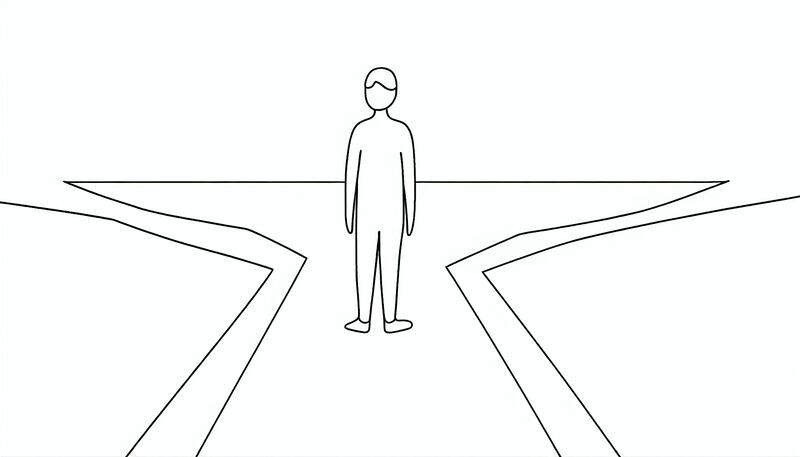
"That's Just Nihilism in a Toga"#
No. This is the most important distinction in the whole philosophy, so let me be blunt about it.
The nihilist says: Nothing matters. That's a claim. A strong, confident, dogmatic claim about the nature of reality. The Pyrrhonist would look at the nihilist and say: "How do you know nothing matters? What's your evidence? Have you examined every possible counterargument?"
The Pyrrhonist doesn't say nothing matters. The Pyrrhonist says: I can't determine whether things matter or not, and I'm not going to pretend I can.
That's not despair. That's honesty.
And there's a word for what the Pyrrhonist is: zetetic. A seeker. Someone who's still looking. They haven't concluded that truth doesn't exist. They've concluded that they haven't found it yet. And unlike the nihilist, who has slammed the door and walked away, the Pyrrhonist leaves it open.
"You're Contradicting Yourself—You're Asserting That Nothing Can Be Asserted!"#
Sextus dealt with this one two thousand years ago and his answer is still the best.
Pyrrhonist statements—"I determine nothing," "to every argument an equal argument is opposed"—aren't dogmatic claims. They're weather reports about the skeptic's mind. Saying "I determine nothing" is like saying "I have a headache." You're describing your current state, not laying down a law of the universe.
And here's the move that makes Pyrrhonism genuinely beautiful: the arguments destroy themselves. Sextus compares them to a ladder you climb and then kick away. Or to a fire that consumes the fuel and then consumes itself. The skeptical arguments eliminate dogmatic beliefs, and then they eliminate themselves.
What's left? Just you. Standing in open air. No framework. No system. No ladder.
Just the world, showing up as it shows up, with nothing between you and it.
Your Brain on Pyrrhonism: Why This Matters Right Now#
The Anxiety Economy#
We live inside a machine designed to manufacture opinions. Every algorithm, every notification, every trending topic is asking you: What do you think about this? Pick a side. Have a take. Post it. Defend it.
And we obey. We form opinions about geopolitical crises we learned about thirty seconds ago. We take firm stances on scientific questions we don't have the training to evaluate. We construct entire identities around positions we adopted because someone we follow on social media held them first.
The result? Anxiety. Constant, low-grade anxiety that you might be wrong, that someone might expose you, that the ground under your opinions isn't as solid as you're pretending. You can feel it right now, can't you? That tightness when someone challenges something you "believe."
Pyrrhonism is the antidote. Not to having thoughts—you'll always have those. But to the strangling grip of certainty. To the exhausting performance of always knowing.
Micro-practice: Next time you're about to post an opinion online, pause for thirty seconds. Ask yourself: "Do I actually know this? Or did I just absorb it from someone who sounded confident?" You don't have to delete the post. Just ask the question. See what shifts.
The Freedom of "I Don't Know"#
There is a specific physical sensation that comes with saying "I don't know" and meaning it. Not "I don't know yet"—which is still a promise that you'll figure it out. Just... "I don't know."
Your shoulders drop. Your jaw unclenches. Something behind your eyes relaxes. The world gets a little wider.
We're taught that "I don't know" is a confession of failure. In a job interview, it's death. In a political debate, it's surrender. The person who changes their mind is "weak." The person who holds their ground—no matter how wrong they are—is "strong."
The Pyrrhonists thought this was insane.
Strength isn't gripping harder. Strength is being able to let go. The person who can say "I was wrong" or "I don't know" or "I haven't figured this out yet" is demonstrating more intellectual courage than every pundit, influencer, and comment-section warrior who has ever lived.
CBT Before CBT Existed#
The foundational insight of cognitive behavioral therapy—that your suffering comes not from events but from your judgments about events—is a Pyrrhonist idea with a modern brand name.
Aaron Beck's cognitive model says: you feel terrible not because you failed, but because you believe failure means you're worthless. The therapeutic move is to identify the belief, find an equally strong counter-belief, and suspend the original judgment.
That's epoché. That's isostheneia. That's Pyrrhonism, dressed up in clinical language and covered by insurance.
Science as Organized Pyrrhonism#
Good science is Pyrrhonism with lab coats. The whole point of the scientific method is that you don't claim final truth. You propose a hypothesis, try as hard as you can to destroy it, and if it survives, you keep it—provisionally, lightly, ready to throw it out the moment better evidence arrives.
Peer review is isostheneia. Replication crises are the ten modes. The best scientists hold their hypotheses the way a Pyrrhonist holds all propositions: like something that might be true, or might not, and either way, the work continues.
The worst scientists—the ones who fake data, suppress contradictory evidence, attack critics personally—are dogmatists. They've confused their model with reality. And every time that happens, the Pyrrhonists are proven right again.
How to Actually Do This#
Not at the end. Not as an afterthought. Right now.
Morning: The Two-Minute Audit#
Before you reach for your phone, sit up and notice what your mind is already doing. It's forming opinions. About the day ahead ("This is going to be brutal"). About how you slept ("Terrible, I'm wrecked"). About what you should be doing ("I'm already behind").
These aren't facts. They're judgments. And you formed them before your feet hit the floor.
Hold each one up. Turn it over. Say "Perhaps." Not as a mantra—as an honest response to the uncertainty of being alive at 7 a.m. on a Tuesday.
The Twitter Test#
Next time you're in a comment section—or at Thanksgiving dinner, or in a meeting where everyone's posturing—and somebody says something you know is wrong, try this:
Don't argue. Don't agree. Don't perform any position at all.
Instead, silently generate the strongest possible case for what they just said. Not a strawman. The real thing. The version of their argument that a thoughtful, intelligent person would make.
Hold it next to your own position. Feel them pull.
You don't have to change your mind. But notice: the rage is gone. The contempt is gone. What's left is something more like curiosity.
That's isostheneia. And you just did it at Thanksgiving dinner.
The Appearance Game#
For one hour, describe everything without interpretation.
Not "this coffee is bad." Try: "This coffee tastes bitter to me right now." Not "She was rude." Try: "She spoke in a tone that I experienced as sharp." Not "Today sucks." Try: "I'm having sensations I don't enjoy."
Stay at the level of appearance. Don't add the story. Don't assign meaning.
Notice how much lighter everything feels when you're not constantly prosecuting reality for failing to meet your expectations.
The Pyrrhonist Phrases#
The ancient skeptics trained themselves with specific verbal formulas. Adopt a few:
— "Perhaps." — "It appears so to me." — "No more this than that." — Que sais-je? — What do I know?
You don't say these out loud (unless you want weird looks). But let them run as background music in your mind. They're not beliefs. They're reminders that you don't have to believe everything you think.
Evening: The Judgment Autopsy#
Before sleep, scan the day. Where did you get disturbed? Not just annoyed—where did you actually suffer?
Now look at what caused it. Was it the event itself? Or was it your judgment about the event? "She should have appreciated my work." "That shouldn't have happened." "I deserve better."
Those "shoulds" and "shouldn'ts"—they're not observations. They're dogma. And they're where the pain lives.
What if you suspended them? Not forever. Not as a philosophy. Just for tonight. Just to see what happens.
Weekly: One Page of Sextus#
Outlines of Pyrrhonism is free online. Read one page a week. Don't study it. Don't take notes. Just let the arguments wash through you and notice how your mind responds to disciplined, patient, relentless doubt. It's 1,800 years old and it reads like it was written by someone who's been watching you argue with strangers on the internet.
The Neighborhood: Who Lives Nearby#
Pyrrhonism and Stoicism are the bitter rivals who secretly agree on everything important. Both say your judgments cause your suffering. The Stoic says: judge correctly. The Pyrrhonist says: stop judging. Same diagnosis, different prescription. The Stoic is the doctor who gives you the right medicine. The Pyrrhonist is the doctor who cures you of needing medicine at all.
Pyrrhonism and Buddhism are the long-lost cousins who may have actually met. Nagarjuna's Madhyamaka arguments about emptiness look almost identical to the Pyrrhonist tropes—and some scholars think that's because Pyrrho brought something back from India. Others say it's convergent evolution: two traditions staring at the same problem and reaching the same non-conclusion. Either way, the resonance is eerie. Both say liberation comes from releasing your grip on views.
Pyrrhonism and Existentialism stared into the same void. The existentialists—Kierkegaard, Camus, Sartre—saw the impossibility of certainty and found anxiety. The Pyrrhonists saw the same thing and found peace. Same cliff. Different response to the view.
Pyrrhonism and Pragmatism are drinking buddies. William James said truth is what works, not what corresponds to some hidden reality. That's basically where the Pyrrhonist lives: in the world of appearances and practical consequences, with the metaphysical questions left permanently open.
Pyrrhonism and Phenomenology share a word. Husserl literally borrowed "epoché" from the Pyrrhonists for his method of bracketing assumptions. He wanted to examine pure experience without metaphysical baggage. The Pyrrhonists had been doing that for two thousand years.
Where to Go From Here#
Five minutes. Sit with this phrase: "No more this than that." Apply it to one opinion you're carrying right now. Not your moral convictions—start with something small. "My coworker is lazy." No more this than that. Feel it?
One evening. Read Book I of Sextus Empiricus' Outlines of Pyrrhonism. Forty pages. Free online. Written by a doctor who thought philosophy was a disease and skepticism was the cure. It's the best introduction there is, and it was written by a practitioner, not a professor.
One week. Read Montaigne's "Apology for Raymond Sebond" alongside Sarah Bakewell's How to Live. Watch a real human being turn Pyrrhonism into something warm, funny, and impossibly alive.
Right now. Think of the next conversation you'll have where you disagree with someone. Don't plan your argument. Plan your silence. Plan the moment where you say—to yourself, not out loud—"It appears otherwise to me, but perhaps."
Notice what happens to the tension in your chest.
Notice the space that opens up.
Essential Reading#
Primary Sources#
- Sextus Empiricus, Outlines of Pyrrhonism — Start here. The Benson Mates translation (The Skeptic Way) is the most readable. Free older translations are online.
- Sextus Empiricus, Against the Professors and Against the Dogmatists — The encyclopedic demolition. For when you want to watch a 2nd-century physician take apart every field of knowledge like a mechanic dismantling an engine.
- Diogenes Laërtius, Lives of the Eminent Philosophers, Book IX — Pyrrho's biography. Part fact, part gossip, all vivid.
Secondary Sources#
- Richard Bett, Pyrrho, His Antecedents, and His Legacy — The definitive scholarly study. Honest about what we don't know, which is a lot.
- Julia Annas and Jonathan Barnes, The Modes of Scepticism — The best guide to the ten and five modes.
- Christopher Beckwith, Greek Buddha — Argues for deep Buddhist influence on Pyrrho. Controversial, fascinating, possibly wrong. (Pyrrho would approve.)
- Richard Popkin, The History of Scepticism — How Pyrrhonism detonated in the Renaissance and reshaped European thought. A masterpiece.
- Sarah Bakewell, How to Live — Montaigne's biography, and the best argument that Pyrrhonism makes you more human, not less.
For the Curious#
- Nassim Nicholas Taleb, The Black Swan — Not explicitly Pyrrhonist, but soaked in the same epistemic humility. Taleb's war on overconfident experts is isostheneia for the 21st century.
- Adrian Kuzminski, Pyrrhonism: How the Ancient Greeks Reinvented Buddhism — Another take on the Eastern connection. More accessible than Beckwith.
Quotes Worth Keeping#
"The things themselves are equally indifferent, and unstable, and indeterminate." — Pyrrho (via Timon, via Aristocles, via Eusebius)
"Epoché is a state of the intellect on account of which we neither deny nor affirm anything." — Sextus Empiricus
"The skeptic, being a lover of his kind, desires to cure by speech, as best he can, the self-conceit and rashness of the dogmatists." — Sextus Empiricus
"Just as it is not impossible for the person who has climbed to a high place by a ladder to overturn the ladder with his foot after the ascent, so it is not impossible for the skeptic, having used the argument as a step, then to destroy the argument itself." — Sextus Empiricus
"Que sais-je?" — What do I know? — Montaigne
"Pound, pound the bag of Anaxarchus—you are not pounding Anaxarchus himself." — Anaxarchus, while being killed
"I dine, I play a game of backgammon, I converse, and am merry with my friends." — David Hume
There's a moment—maybe you've had it, maybe you haven't yet—where you stop pretending. Where you put down the performance of knowing and sit in the raw, terrifying, gorgeous openness of not-knowing.
Everything you've been clenching relaxes. The arguments you were rehearsing in the shower dissolve. The identity you were defending turns out to be optional. The ground you thought you were standing on was never there—and it turns out you can float.
Twenty-three centuries ago, a painter from a small Greek town walked to the edge of the known world, met people who had stopped grasping, and came home changed. He didn't build a system. He didn't write a manifesto. He pointed at a pig in a storm and said: like that.
The peace was never in the answers.
It was in the breath before you decided you had them.
Perhaps.
Talk about it · 4 questions
- What is the difference between Pyrrhonian doubt and simply not caring?
- Can a person really live without firm beliefs? How did the Pyrrhonists answer this?
- Why might the pig calmly eating in the storm be a picture of wisdom?
- Where in daily life would suspending judgement help, and where might it harm?