The Absinthe Wing · Modern European
Absurdism
Life is meaningless. Now go live it anyway.
They found an unused train ticket in Camus's pocket after the car crash that killed him at forty-six — the ticket that would have saved his life. The man who argued we must face the absurd died in the most absurd way imaginable. Absurdism doesn't fix the meaninglessness of life — it dances with it, and somewhere in that defiant joy, meaning sneaks in through the back door.
In 5 minutes
Absurdism, from Albert Camus, says life has no meaning given from outside, yet we can still live fully and joyfully.
- The absurd is the clash between our need for meaning and the world’s silence.
- Camus rejects escape, either into false hope or giving up on life.
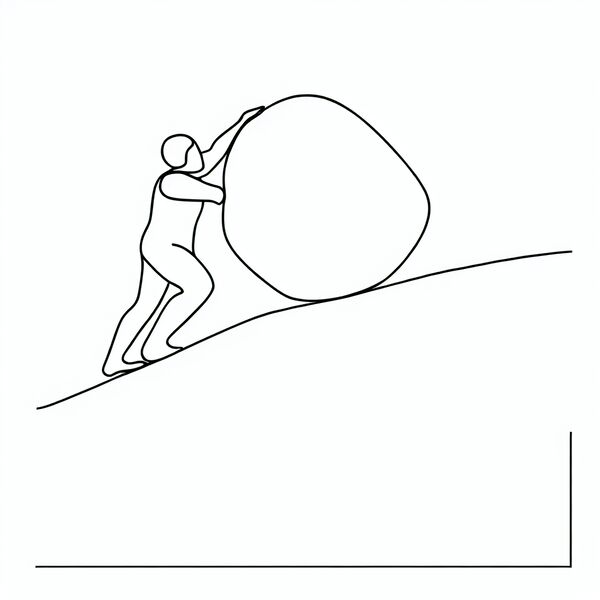
- We must imagine Sisyphus happy: living with eyes open is a form of revolt.
Try today: Do one small thing purely for the joy of it — sit in the sun, swim, listen to a song — with no goal.
Jump to the practiceBefore you go in…
One small question at the door. No right answers, just yours, and then how Absurdism would reason about it.
It's a grey Monday. You've just asked why any of this matters, and the universe, as usual, hasn't answered. What do you do with that silence?
Content note: This room discusses death and suicide. If you're struggling, help is here — Tele-MANAS 14416 (India) · findahelpline.com.
The Unused Train Ticket#
On January 4, 1960, a black Facel Vega HK500 wrapped itself around a plane tree on a straight stretch of road near Villeblevin, a small town in Burgundy, France. The driver, Michel Gallimard — nephew of Camus's publisher — would die six days later. His passenger, Albert Camus, was killed instantly. He was forty-six years old.
When rescuers pulled his body from the wreckage, they found two things that still haunt anyone who knows the story: an unfinished manuscript — 144 handwritten pages of an autobiographical novel called The First Man — and an unused train ticket.
Camus had planned to take the train back to Paris. His wife Francine and their twin children had already traveled home by rail. At the last moment, his friend Michel convinced him to ride along in the car instead.
A split-second decision. A meaningless accident on a meaningless stretch of road.
If you'd hired a screenwriter to design a death that proves absurdism — the idea that the universe is cosmically, spectacularly indifferent to your plans — you couldn't top this. The man who spent his life arguing that we must face the absurd died in the most absurd way imaginable: killed by a random car crash, with a train ticket in his pocket that would have saved his life.
Camus opened The Myth of Sisyphus with the line: "There is but one truly serious philosophical problem, and that is suicide." Not because he wanted to die — but because he wanted to figure out why we should keep living in a universe that offers no reason to.
He found his answer. Then a plane tree took him before he could finish telling us the rest.
The unfinished manuscript of The First Man wouldn't be published until 1994, when his daughter Catherine finally brought it into the world. It was a return to the beginning — Algeria, the apartment with no electricity, the mother who couldn't hear him, the father he never knew. He was, at the end, circling back to where it all started.
To understand absurdism, you have to understand that beginning.
A Deaf Woman, a Dead Father, and the Mediterranean Sun#
Albert Camus was born on November 7, 1913, in Mondovi, a small village in French Algeria. Not Paris. Not the Left Bank. Not anywhere that produced philosophers. His father, Lucien, was a poor agricultural worker with barely any education. His mother, Catherine Hélène Sintès, was of Spanish descent, partially deaf, and illiterate.
She could not read a single word her son would ever write.
Let that land. The man who would win the Nobel Prize in Literature at forty-four — the second-youngest recipient in history — had a mother who could never read his books. Imagine getting the call from Stockholm and knowing the person you most want to share it with can't understand what you've done. That gap — between what you feel and what the world gives back — that's the absurd right there. Camus didn't learn it from a textbook. He lived it before he could spell it.
When Camus was less than a year old, World War I broke out. His father was called up to fight. On October 11, 1914, Lucien was killed by shrapnel at the First Battle of the Marne. Albert never knew him. The only story he ever heard about his father: Lucien had once witnessed a public execution and come home so shaken he vomited for hours.
That single inherited memory — his father's visceral revolt against death administered by the state — stayed with Camus for life. It fueled his passionate, career-defining opposition to the death penalty. One story, passed down from a dead man to a boy who never met him, shaped an entire philosophy. If that's not absurd, nothing is.
After Lucien's death, Catherine moved with her two boys to the Belcourt district of Algiers. Working-class. Three rooms, no bathroom, no electricity, no running water. Catherine's mother — a domineering woman who disciplined the children with a whip made of cord — ran the household. Catherine cleaned houses and worked in a munitions factory. She spoke little, not just because of her deafness, but because she was quiet by nature. Almost spectral. She moved through the apartment like someone visiting from another world.
Camus loved her desperately. She loved him back in her silent way. But they could barely communicate. In The First Man, he'd write about this with devastating tenderness — the gulf between them, the love that couldn't find words, the boy who achieved everything and the woman who couldn't understand what any of it meant.
This is where absurdism was born. Not in a seminar room. Not over espresso on the Boulevard Saint-Germain. In a cramped apartment in Algiers where a deaf woman mopped floors and a fatherless boy looked up at the Mediterranean sun and felt, simultaneously, the blazing beauty of being alive and the complete indifference of the world to his existence.
Try this, right now: Think about the person in your life who loves you the most but understands you the least. The parent who doesn't get what you do for work. The friend who supports your dream without comprehending it. That love across a gulf of incomprehension — that's the absurd in its gentlest, most human form.
The Teacher Who Saved Everything#
If there's a single turning point in Camus's life, it's a schoolteacher named Louis Germain.
Germain taught at the local école communale and spotted something electric in the quiet boy from Belcourt. Camus's grandmother had plans for him — get a job, start contributing. Manual labor. No patience for education. But Germain saw further. He gave Camus free private lessons, prepared him for a scholarship exam, and fought — actually fought the family — to keep him in school.
Camus won the scholarship. He went to the Grand Lycée in Algiers, then the University, where he studied philosophy.
When Camus won the Nobel Prize in 1957, his first letter wasn't to a publisher or a fellow intellectual. It was to Germain:
"When I heard the news, my first thought, after my mother, was of you. Without you, without the affectionate hand you extended to the small poor child that I was, without your teaching and example, none of all this would have happened."
Germain wrote back, addressing the Nobel laureate as "my little Camus."
I think about this every time someone reduces absurdism to an abstract philosophical position. Camus wasn't theorizing about meaninglessness from a leather armchair. He was a war orphan raised in poverty, by a woman who couldn't hear or read, in a colonized country, with tuberculosis that hit him at seventeen and nearly killed him. He knew the universe didn't care — not as a thought experiment, but as a daily lived experience. The question was never academic. It was: given all this, why get out of bed?
That's the question, by the way. Not "what is the meaning of life?" That's a dorm room poster. The real question is: Is life worth living when you already know the universe won't answer back?
The Body's Betrayal#
In 1930, Camus coughed blood. Tuberculosis. He was seventeen. In the 1930s, this was often a death sentence.
He had to leave the family apartment — TB was contagious — and move in with an uncle. He could only study part-time. His dreams of becoming a football goalkeeper (he'd played with real passion and talent for the Racing Universitaire d'Alger) were finished. The disease would recur throughout his life, sending him to sanatoriums, limiting his travel, shadowing everything.
But here's the thing about almost dying young: it clarifies your priorities with brutal efficiency. When you've tasted your own mortality in a mouthful of blood at seventeen, you don't waste time on questions that don't matter. You go straight to the essentials. Is life worth living? What do we do with the time we have? How do you face a world that can snatch everything away without warning?
These aren't philosophical questions for Camus. They're survival questions. The same questions you ask at 3am when the anxiety hits and you're lying in bed staring at the ceiling, suddenly aware that you're going to die and nobody can tell you what any of this is for. The same questions that flash through your mind when the doctor says "we found something" or when you're refreshing your email for the forty-seventh time waiting on a response that will determine the next chapter of your life and the universe just... doesn't care. Doesn't even notice.
Camus later wrote: "I learned that a ball never arrives from the direction you expected it. That helped me in later life." He was talking about football. He was talking about everything.
The Collision: What the Absurd Actually Is#
Here's the most common misunderstanding of absurdism: people hear "the absurd" and think it means "life is silly" or "nothing matters, lol."
No. The Absurd is not a vibe. It's a collision.
On one side: you. A human being who craves meaning the way you crave oxygen. You can't help it. You look at the stars and want them to be for something. You fall in love and want it to last forever. You work for decades and want it to mean something. You check your phone 96 times a day hoping for a notification that makes you feel like you matter. Every fiber of your consciousness reaches out for pattern, for purpose, for the point.
On the other side: the universe. Silent. Gorgeous. Brutal. It offers no answers. The sun rises, cells divide, tectonic plates shift, stars explode — and none of it is for anything. Your emails go unanswered by the cosmos. Your five-year plan doesn't register on any celestial dashboard.
The Absurd is what happens when these two collide. It's the feeling you get standing at a funeral when the sky is impossibly blue. When the world is ending on your news feed but the birds outside are still singing. When you spend three months on a project and it gets cancelled in a one-line Slack message. When you apply for a job you don't even want because the system demands you perform ambition for a role that will eat your life.
Camus put it like this:
"The absurd is born of this confrontation between the human need and the unreasonable silence of the world."
You want answers. The universe hums. That gap — that electric, unbearable, weirdly beautiful gap — is where absurdism lives.
Try this: The next time something happens that makes absolutely no sense — a senseless tragedy, a random stroke of luck, a Tuesday that feels like it was scripted by someone who gave up halfway through — don't explain it. Don't reach for "everything happens for a reason." Just let the gap be there. Feel it. That's the Absurd, and it's been there your whole life. You've just been papering over it.
Three Doors. Only One Stays Open.#
Once you've really felt the Absurd — not just understood it, but felt it like a punch — Camus says you have three options. Three doors. Two of them are locked from the inside.
Door One: Quit#
The most literal response. If life has no meaning, why continue? Camus considered this the central philosophical question — not because he was morbid, but because he was honest. He rejected it. Not because life secretly has meaning you just need to find, but because quitting is surrendering. It's letting the Absurd win. It's saying: a life without guaranteed meaning isn't worth having. Camus refused that conclusion with everything he had.
Door Two: The Leap (or, Lying to Yourself Very Convincingly)#
This is what Camus saw in religion and in certain philosophies. You feel the Absurd — the gap between your need for meaning and the universe's silence — and then you leap over it. You declare God exists, or history has a purpose, or the universe has a plan. For Camus, this was intellectual dishonesty. Not because he hated religion. Because it "solves" the problem by pretending it doesn't exist. It's like treating a broken leg by refusing to look at it.
He called this "philosophical suicide" — killing the question instead of living with it. And he saw it everywhere: in Kierkegaard's leap of faith, in Marxist historical determinism, in every ideology that promises a final answer if you just believe hard enough.
(He'd have a field day with the modern self-help industrial complex. "Manifest your reality." "The universe is conspiring in your favor." Camus would have taken a very long drag on his cigarette and said, no, it isn't.)
Door Three: Stay in the Room#
Don't quit. Don't pretend the gap isn't there. Instead: live in the tension. Acknowledge that life has no inherent meaning — and then live passionately, fully, defiantly anyway. Not because you've cracked the code, but because the act of living fully in spite of meaninglessness is itself a rebellion against the indifferent universe.
This is the heart of absurdism. It's not nihilism dressed up in a French accent. It's the most stubborn, beautiful form of courage there is: persisting without the promise of a reward. Pushing the boulder knowing it'll roll back. Getting out of bed on a gray Monday knowing nobody in the cosmos cares whether you do.
And finding — somehow, against all logic — that the pushing itself fills something inside you that nothing else can.
Sisyphus, or: The Most Important Happy Ending Ever Written#
This is why Camus chose Sisyphus.
You know the myth. Sisyphus, king of Corinth, pissed off the gods. His punishment: push a boulder up a mountain, watch it roll back down, walk back to the bottom, push it up again. Forever. No parole. No appeal. No "personal growth journey."
Most people look at Sisyphus and see a horror story.
Camus looked at Sisyphus and saw a hero.
Why? Because Sisyphus knows. He knows the boulder will roll back. He knows the task is pointless. And he pushes anyway. And it's that moment — the moment after the boulder rolls down, when Sisyphus turns and walks back to the bottom — that fascinated Camus. That's the moment of full consciousness. No illusions. No hope of escape. Just clear-eyed awareness of exactly how futile his situation is.
And Camus writes this:
"The struggle itself toward the heights is enough to fill a man's heart. One must imagine Sisyphus happy."
The most famous line he ever wrote. He wasn't being ironic. He meant it. The happiness doesn't come from the boulder reaching the top — it never stays there. The happiness comes from the pushing. From the refusal to stop. From consciousness itself.
Sound familiar? It should. You're Sisyphus every Monday morning. You're Sisyphus every time you start a new diet knowing your track record. You're Sisyphus sending your manuscript to the forty-third literary agent. You're Sisyphus trying to explain to your parents what you do for a living. You're Sisyphus swiping through dating apps at 11pm looking for connection in a format designed to make connection impossible.
The boulder always rolls back. You walk back down. You push it again.
The question isn't whether the boulder will stay at the top. It won't. The question is: can you find something in the pushing — in the burning muscles, the ragged breath, the halfway point where you almost quit but didn't — that makes it worth doing anyway?
Camus says yes. And he's the most persuasive person who ever made that argument, because he made it while coughing blood into handkerchiefs and dodging Nazi patrols and losing every friend he had.
Try this: Identify your boulder. Not the one you wish you had — the one you're actually pushing. The job, the relationship, the creative project, the recovery, the endless laundry. Now ask: not "will it stay at the top?" but "is there anything in the pushing I'd miss if it stopped?" If the answer is yes — even a small, quiet yes — you've found what Camus was talking about.
The Resistance, the Breakup, and the Stranger: Absurdism Gets Real#
Camus Goes Underground#
When the Germans invaded France in 1940, Camus tried to enlist. Rejected — tuberculosis. So he found another way.
By 1943, he was editor-in-chief of Combat, one of the most important underground newspapers of the occupation. He wrote editorials under pseudonyms, organized clandestine printing, and risked execution daily.
Here's what makes this absurdist and not just heroic: Camus had no illusions about the war being part of some grand moral arc. He didn't believe the universe was on the Allies' side. He didn't fight because justice would "inevitably triumph." He fought because people were being oppressed and killed, and that was enough reason. No cosmic justification required.
After the liberation of Paris, he wrote in Combat: "This terrible labor will give birth to a revolution." Was he right? Partly. Was he naive? Partly. Did he act anyway? Absolutely.
That's the whole philosophy in one life: act without guarantees. Show up without knowing it'll work. Care about things you can't control the outcome of.
You do this more than you think, by the way. Every time you vote in an election you know is rigged by money. Every time you recycle while corporations dump millions of tons of waste. Every time you text someone you love knowing they might not text back. Small revolts. Sisyphean revolts. Camus would recognize every one.
The Most Famous Friendship Divorce in Philosophy#
In the early 1940s, Camus and Jean-Paul Sartre were friends. Twin stars of French intellectual life — spotted together at the Café de Flore, debating through the night with Simone de Beauvoir and the rest of the Left Bank crowd.
Beneath the friendship, a fault line was forming.
It cracked open with Camus's The Rebel in 1951. In that book, Camus argued against revolutionary violence — against the Marxist idea that you can justify murder today in the name of a utopia tomorrow. He wrote about the French Revolution's Reign of Terror, about Stalin's purges, about the way ideologies that promise paradise always seem to require mass graves along the way.
His position: rebellion yes, revolution no. Revolt against injustice, but never lose sight of the individual human life in front of you. The moment you decide the end justifies the means — that some people deserve to die for the greater good — you've become the thing you set out to fight.
Sartre, who was sympathetic to Marxism and the Soviet project took this personally. He assigned his protégé Francis Jeanson to write a devastating review. Camus fired back with an open letter addressed to "Monsieur le Directeur" — to Sartre himself. Sartre's reply was both brilliant and cruel: "My dear Camus, our friendship was not easy, but I will miss it."
They never spoke again.
History sided with Camus. Stalin's crimes aren't debatable anymore. But at the time, the Parisian intelligentsia mocked Camus as a naïf, a moralist, a man too simple for real philosophy.
He was right, and it cost him everything. That's absurdism lived — not theorized.
(And if you've ever been the person in a friend group who said the uncomfortable true thing and watched everyone turn on you? You know this feeling. Smaller stakes, same mechanism.)
Meursault: The Man Who Refused to Fake It#
The opening of The Stranger (1942) is one of the most famous lines in all of literature:
"Mother died today. Or yesterday maybe, I don't know."
The protagonist, Meursault, doesn't grieve the way society expects. He doesn't cry at his mother's funeral. He goes swimming the next day. Starts a relationship. Goes to the movies. Later, on a sun-drenched beach, he shoots and kills an Arab man — and when asked why, he says it was because of the sun.
He's convicted and sentenced to death. But — and this is the knife in the ribs — he's not really convicted for the murder. He's convicted for being honest. For not performing grief. For refusing to cry on cue, for not pretending life came with an instruction manual for how to feel.
We live in an age that would convict Meursault even faster. Think about it. We perform emotions constantly now — the Instagram grief post, the LinkedIn "grateful to announce" humblebrags, the mandatory enthusiasm in every work email. We've built entire social architectures around pretending to feel things at the correct intensity at the correct time. Meursault's crime is a crime we commit in reverse every day: he refused to fake it. We never stop faking it.
The Stranger isn't a celebration of not caring. It's an X-ray of what happens when someone refuses to perform meaning they don't feel — and how violently the world punishes that refusal.
The Plague: Showing Up When Nothing Makes Sense#
The Plague (1947) is Camus at his most humane. A bubonic plague descends on the city of Oran, killing thousands. The hero, Dr. Rieux, fights it day after day, knowing he can't win. He treats the sick, comforts the dying, organizes sanitation — not because God will reward him, not because the universe is just, but because people are suffering and he can help.
When asked why, Rieux gives maybe the most Camusian answer in all of literature:
"It's a matter of common decency."
No grand philosophy. No cosmic justification. People are suffering, so you help. That's it. That's enough.
Read as an allegory for the Nazi occupation (which Camus intended), The Plague says something that applies to every crisis, including the ones we're living through now: you don't need to understand it. You don't need it to make sense. You just need to show up and do what you can.
Try this: Next time you're overwhelmed by the state of the world — the news, the politics, the climate data — stop trying to understand it. Stop looking for the narrative. Instead, ask: What's the most decent thing I can do today? Not the most heroic. Not the most Instagram-worthy. The most decent. Rieux didn't save Oran. He just showed up every day. That's all the philosophy asks.
The Fall: Who You Are When No One's Watching#
The Fall (1956) is darker. A former Paris lawyer named Jean-Baptiste Clamence tells his story in an Amsterdam bar. He was once a model citizen — generous, principled, admired. Then one night, walking across a bridge, he heard a woman jump into the Seine.
He paused. He did nothing. He walked on.
That moment of cowardice haunted him forever. The Fall is about the gap between who we present ourselves as and who we actually are when tested. It's the Absurd applied to identity itself: the narrative you've built about your own virtue — and the moment it collapses.
We all have a version of that bridge. The comment section you scrolled past. The friend you didn't call back. The moment you could've said something and didn't. The Fall doesn't condemn you for it. It just refuses to let you forget.
"But Isn't That Just Nihilism?" No. Sit Down.#
This is the correction that needs to happen every single time someone encounters absurdism for the first time, because almost everyone gets it wrong.
Nihilism: Nothing matters. Give up. Order another drink.
Absurdism: Nothing matters inherently. The universe won't hand you a purpose. So build your own, hold it fiercely, and know — with full consciousness — that it's yours and yours alone.
The nihilist and the absurdist both start from the same observation: the universe is indifferent. Same trailhead, opposite directions. The nihilist sits down. The absurdist laughs, rolls up their sleeves, and starts building.
Camus: "In the midst of winter, I found there was, within me, an invincible summer."
That's not nihilism. That's a man who stared into the void and found something the void couldn't touch.
Here's why the distinction matters practically: nihilism gives you permission to stop caring. Absurdism gives you permission to care without needing a guarantee that your caring will be rewarded. That second permission is far more dangerous, far more radical, and far more useful — because it's what you actually need at 2am when you're wondering why you bother.
You bother because the bothering is the point.
The Age of Absurdity (or, Why Camus Predicted Your Life)#
We live in Camus's world now. He just got here first.
The old meaning-making structures — religion, nationalism, the career ladder, the idea that if you get the degree and the job and the house you'll feel complete — are crumbling for a lot of people. Not for everyone. But if you've ever had the experience of achieving something you were supposed to want and feeling... nothing? Or worse, feeling the same low-grade anxiety you had before, just with a nicer apartment? That's the Absurd. That's the confrontation Camus described in 1942, playing out on your IKEA couch in 2026.
We check our phones 96 times a day looking for meaning in the form of likes, replies, breaking news. We optimize our routines, track our sleep, quantify our steps, trying to turn life into a solvable problem. We apply for jobs we don't want to buy things we don't need to impress people we don't like — and somewhere underneath all that performance, there's a voice saying: but what is this actually for?
That voice is the Absurd. And you can respond to it the way Camus suggested: not by finding the answer (there isn't one), but by living so fully and so stubbornly that the question becomes less important than the living.
Absurdism and Therapy (They're Closer Than You Think)#
A growing number of therapists draw on absurdist ideas — not by name, usually, but in spirit:
Acceptance and Commitment Therapy (ACT) says: accept difficult thoughts and feelings rather than fighting them, then commit to actions aligned with your values. That's Camus's revolt in clinical language.
Existential therapy says: confront the givens of existence — death, freedom, isolation, meaninglessness — and find authentic ways to live with them. That's The Myth of Sisyphus with a billing code.
Viktor Frankl's logotherapy — developed by a Holocaust survivor — arrived at conclusions strikingly similar to Camus's from a very different starting point: meaning isn't found, it's made, through action, love, and how you carry your suffering.
If you've ever sat in a therapist's office and heard something like "you can't control what happens, only how you respond," congratulations — you've received a paraphrase of Camus. He just said it with better sentences and a cigarette.
How to Actually Live This (Without Moving to Algeria)#
Absurdism isn't a belief system you subscribe to. It's a way of being in the world. And it's less about grand gestures than about a thousand small shifts in how you pay attention.
Mornings#
Wake up. Notice you're alive. This was not guaranteed and was never promised. Skip the affirmations. Try instead: I don't know what today means. I'm going to live it anyway.
Do something physical. Camus swam. Walk, run, stretch — feel your body. The Absurd lives in your head; your body is the escape hatch.
When Things Fall Apart#
Something will go wrong today. When it does, practice not saying "everything happens for a reason." Try instead: That happened. Now what?
This is surprisingly hard. We're addicted to narrative. We want the bad thing to be for something — a lesson, a redirection, divine intervention. Camus asks you to let it be what it is: a bad thing that happened. And then to act anyway.
The Decency Practice#
Once a day, do something for someone else — not for karma, not for your personal brand, not because the universe is keeping score. Because they're suffering and you can help. Dr. Rieux's philosophy. Common decency. The most radical act in an age of performance.
Evening#
Savor something. Really savor it. A meal, a conversation, a sky. The Absurd, paradoxically, makes you a connoisseur of the ordinary. When nothing is guaranteed, everything is a gift you didn't earn and can't explain.
Don't need the day to "add up." It doesn't have to. You lived it. That's the whole thing.
The Words He Left Behind#
Camus wrote sentences that people tattoo on their bodies. That's not an exaggeration — search Instagram. Here are the ones that matter most, and why they matter:
"There is but one truly serious philosophical problem, and that is suicide." — Opening of The Myth of Sisyphus. Not morbid. Honest. Before you philosophize about anything, answer this: why stay?
"The struggle itself toward the heights is enough to fill a man's heart. One must imagine Sisyphus happy." — The closing. The whole essay builds to this. Meaning comes from the struggle, not the summit.
"In the midst of winter, I found there was, within me, an invincible summer." — From "Return to Tipasa" (1954). He revisited the Algerian ruins where he'd been happy as a young man and found that joy can survive anything. Anything.
"The absurd does not liberate; it binds." — From The Myth of Sisyphus. A rebuttal to the idea that if nothing matters, you can do whatever you want. Recognizing meaninglessness doesn't excuse cruelty. It actually demands more responsibility, because you can't hide behind a divine plan.
"I should like to be able to love my country and still love justice." — Nobel Prize speech, 1957. During the Algerian War. A French Algerian who loved Algeria but opposed violence on all sides. The loneliest position in any political debate.
"Man is the only creature who refuses to be what he is." — The Rebel. The human capacity for revolt — for saying no, this is not acceptable — is what makes us human. Not reason. Refusal.
"The only way to deal with an unfree world is to become so absolutely free that your very existence is an act of rebellion." — Widely credited to Camus, but it doesn't appear in The Rebel or his other books; treat it as a modern paraphrase of his spirit. Freedom isn't a condition. It's a posture. It's a way of walking through a world that's trying to make you smaller.
"There is no sun without shadow, and it is essential to know the night." — The Myth of Sisyphus. The vast and the trivial sit at the same table: you feel the meaninglessness, and you pour the coffee anyway. And the coffee is good.
"Real generosity toward the future lies in giving all to the present." — The Rebel. Stop sacrificing today for a utopian tomorrow. The Soviets tried that. It didn't work. Live now.
"I leave Sisyphus at the foot of the mountain. One always finds one's burden again." — The Myth of Sisyphus. The boulder rolled back. Sisyphus walks down. That walk — conscious, unhurried, clear-eyed — is where the happiness lives. Not at the top.
Where Absurdism Sits (and Who It Fights With)#
vs. Existentialism#
Camus rejected the existentialist label, and he was right to. The difference is subtle but it matters:
Existentialism (Sartre, Beauvoir) says: there's no inherent meaning, so you must create it through your choices. You are "condemned to be free." Heavy emphasis on responsibility and self-creation.
Absurdism says: there's no inherent meaning, and you probably can't fully create one either — the gap between you and the universe is permanent. But you can live in that gap. You can make the gap your home. And the living-in-it is itself enough.
Existentialism says: make meaning. Absurdism says: the making will never be complete, and that's okay. The trying is the thing.
vs. Nihilism#
Nihilism is absurdism without the courage. Same diagnosis, opposite prescription. The nihilist sees the void and quits. The absurdist sees the void and goes swimming.
vs. Stoicism#
These two are closer than people expect. Both involve accepting harsh reality. But Stoicism seeks peace — tranquility through control of your responses. Absurdism seeks passion — joy through defiant engagement with an indifferent world. The Stoic accepts the boulder. The absurdist pushes it with a grin.
vs. Buddhism#
Unexpected resonance here. Buddhism's dukkha — the unsatisfactoriness of clinging to impermanent things — maps onto the Absurd remarkably well. Both ask you to let go of the demand that life conform to your expectations. The difference: Buddhism offers a systematic path to liberation from suffering. Absurdism says suffering is part of the deal — don't escape it, live through it. The Buddhist sits with the boulder. The absurdist pushes it, sweating, alive, refusing to pretend it's not heavy.
If You Read Nothing Else#
You have one hour. Here's what to do:
Read the last four pages of The Myth of Sisyphus — just the section about Sisyphus himself. It's the heart of everything.
Sit with this sentence: "One must imagine Sisyphus happy." Don't agree or disagree. Just sit with it. Think about the last time you pushed something uphill knowing it would roll back — at work, in love, with your health, with the dishes that are never done. Did you find anything in the pushing?
Ask yourself the real question: not "what is the meaning of life?" but "Given that the universe won't tell me — is life still worth living?" If your answer is yes, you're already an absurdist. You just didn't have the word for it.
Then read The Stranger. It's short. Under 150 pages. You'll finish it in an afternoon and think about it for the rest of your life.
Then go outside. Feel the sun if there is any. Camus grew up under the Mediterranean sky and never forgot it. You don't think your way into absurdism. You live your way into it — through your body, through sensation, through the stubborn act of being present in a world that never asked for your presence and won't notice when you leave.
Where to Go Deeper#
Start with: The Myth of Sisyphus (1942) — short, readable, life-changing. Start with the first chapter and the final section on Sisyphus. Skip the literary criticism in the middle on your first pass.
Then: The Stranger (1942) — his most famous novel. The Matthew Ward translation is the best.
Then: The Plague (1947) — his warmest book. Read it when you need to believe in showing up.
Then: The Rebel (1951) — harder, denser, angrier. Where he takes on the idea that the ends justify the means and demolishes it. Essential for understanding the Sartre split.
Finally: The First Man (1994, posthumous) — the unfinished novel found in the wreckage. Heartbreaking, beautiful, incomplete. The most absurdist of all his works because it literally could not be finished. Read it last.
Biography: Albert Camus: A Life by Olivier Todd — definitive, thorough, gives you the full human behind the philosophy.
Counterpoint: The Meursault Investigation by Kamel Daoud (2013) — a brilliant Algerian novel that retells The Stranger from the perspective of the Arab who was killed. A necessary reckoning with Camus's blind spots about colonialism. You can't love a thinker honestly without confronting where they got it wrong.
He was forty-six when the plane tree stopped the car. He had an unused train ticket in his pocket and an unfinished novel in his briefcase. The universe offered no explanation. It never does.
But in the years he had — the Algerian sun, the football matches, the tuberculosis wards, the underground newspapers, the Nobel stage, the café arguments that ended friendships, the novels that made strangers on other continents feel less alone — he lived more fully and more honestly than most people who get twice as many years.
The boulder rolled back down. It always does.
One must imagine Camus happy.
Talk about it · 4 questions
- How is absurdism different from nihilism, according to the essay?
- Why does Camus say we must imagine Sisyphus happy?
- How did Camus’s childhood in Algeria shape his ideas?
- What does the essay say about Camus’s blind spots on colonialism?