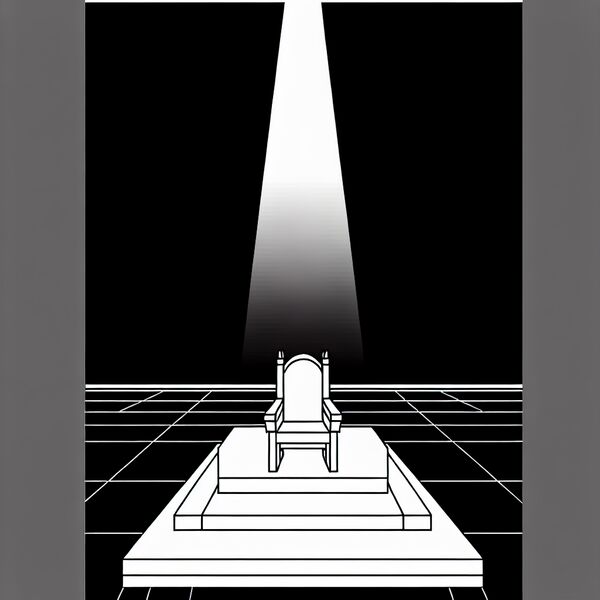
The Absinthe Wing · Modern European
Nihilism
The philosophy that burned down your house and left you the matches
3 AM. Ceiling. That promotion you killed yourself for? You got it. You celebrated for forty-eight hours. Then Monday came and something inside you went oh. Nihilism is the honest, unflinching acknowledgment that the universe doesn't come with instructions. What you do with that silence defines everything.
In 5 minutes
Nihilism is the view that life has no built-in meaning or values; the question is what you do after facing that.
- Nietzsche’s "God is dead" describes old values losing their power.
- Passive nihilism gives up; active nihilism clears ground for new values.
- Thinkers like Camus, Frankl and Beauvoir faced the void and built meaning.
Try today: Write one value you hold because you chose it, not because someone told you to, and do one act for it.
Jump to the practiceBefore you go in…
One small question at the door. No right answers, just yours, and then how Nihilism would reason about it.
It's late. You notice you've stopped believing in the goals you were handed: the career ladder, the rules, the 'shoulds.' What happens next?
Content note: This room discusses death and suicide. If you're struggling, help is here — Tele-MANAS 14416 (India) · findahelpline.com.
You've Already Felt It. You Just Didn't Have the Word.#
3 AM. You're staring at the ceiling. Not drunk, not sad exactly—just awake in that awful, clarifying way where your brain decides to stop lying to you.
That promotion you killed yourself for three years to get? You got it. You celebrated for maybe forty-eight hours. Then Monday came and you were sitting at a slightly bigger desk doing slightly more important versions of the same meaningless work, and something inside you went oh.
Or maybe it was the day you deleted Instagram and waited for someone to notice. Nobody did. Two weeks. Three. Your best friend didn't text. Your ex didn't wonder where you went. You'd been performing your life to an empty theater, and the silence when you stopped was so loud it made your ears ring.
Or maybe—and this is the one that really gets people—it was the moment after you finished the last episode of the show you'd been binge-watching for weeks. That hollow, physical emptiness. You just sat there. The credits rolled into autoplay for the next show and you couldn't even move your thumb. For a second, the void wasn't a metaphor. It was the shape of your evening.
That feeling? Philosophers have a word for it. Several words, actually, in several languages, spanning about twenty-five centuries.
The word is nihilism. And it's the most dangerous, most liberating, most misunderstood idea in the entire history of human thought.
Dangerous because once you really get it, you can't unget it. Liberating because—well. We'll get there.
First, a dead Russian has something to tell you.
A Med Student Ruins Dinner: How Nihilism Got Its Name#
Russia, 1862. The country is a mess—serfdom just abolished, universities full of angry kids with big ideas and bad haircuts, the whole aristocratic order creaking like a house in a storm. A novelist named Ivan Turgenev publishes Fathers and Sons and accidentally invents a brand.
His protagonist, Yevgeny Bazarov, is a medical student who comes home from university and proceeds to ruin every family dinner for the rest of the novel. He's the guy at the party who won't stop pointing out that the music is derivative, the wine is overpriced, and your deeply held beliefs are just things your parents told you before you could think straight.
When asked what he actually believes, Bazarov says: "A nihilist is a man who does not bow down before any authority, who does not take any principle on faith."
The word comes from Latin—nihil, nothing. But Turgenev made it breathe. Bazarov doesn't just reject God or tradition. He rejects poetry. He rejects feelings. A good chemist, he says, is worth twenty poets.
And then—because Turgenev is a genius and not a propagandist—Bazarov falls in love. Completely, humiliatingly, against-everything-he-stands-for in love. The woman, Madame Odintsova, doesn't love him back. And then he dies of typhus from a careless cut during an autopsy. A random, stupid death. The nihilist who rejected meaning gets destroyed by meaninglessness in the most literal way possible.
Micro-practice #1: Think of the last time you said something "didn't matter" to you when it clearly did. A job you didn't get. A text that wasn't returned. Why did you pretend? Who taught you that caring was weakness?
The Russian youth didn't read Bazarov as a cautionary tale. They read him as a hero. Throughout the 1860s and '70s, students, women, revolutionaries adopted the nihilist label with the same energy your friend adopts a new personality after a single therapy session. They cut their hair, rejected arranged marriages, studied science, built communes. Some threw bombs. Most just refused to play along—looked at a society built on serfdom and Orthodox piety and aristocratic theater and said no, actually, we're done pretending this makes sense.
The first thing to understand about nihilism: it was born from refusal, not surrender. From too much caring, not too little.
The Day God's Funeral Went Unnoticed#
If Turgenev named nihilism, Friedrich Nietzsche performed its autopsy.
There's a scene in The Gay Science (1882) that still hits harder than anything published since. It's called the Parable of the Madman, and it goes roughly like this:
A guy lights a lantern in broad daylight, runs into the town square, and starts screaming: "I seek God! I seek God!"
People laugh. Atheists, mostly. Has God gone on vacation? Did he get lost?
The madman stares them down:
"Where is God? I will tell you. We have killed him—you and I. All of us are his murderers. How could we drink up the sea? Who gave us the sponge to wipe away the entire horizon? What were we doing when we unchained this earth from its sun? Are we not plunging continually? Backward, sideward, forward, in all directions? Is there still any up or down?"
Silence. He smashes his lantern.
"I have come too early," he says. "This deed is still more distant from them than the most distant stars—and yet they have done it themselves."
Here's what everyone gets wrong about this: Nietzsche isn't throwing a party. He's sounding an alarm. "God" doesn't mean the bearded guy in the clouds. God means the entire operating system of Western meaning—two thousand years of Christianity providing answers to why you should be good, why suffering makes sense, what your life is for.
Science, rationalism, Darwin, historical criticism—they didn't replace that operating system. They just uninstalled it. And now we're all standing around with blank screens wondering why nothing works, and most of us haven't even realized the system crashed.
That's nihilism according to Nietzsche. Not a philosophy you choose like picking a major. A condition that arrives whether you want it or not. Like finding out Santa isn't real, except Santa was the entire foundation of your civilization.
The Fork in the Road (And Why Most People Take the Wrong One)#
Nietzsche saw two responses to the crash:
Passive nihilism is what happens when you encounter the void and just... stop. Nothing matters, so why try? This is the "last man" from Thus Spoke Zarathustra—comfortable, mediocre, binge-watching his way through existence, occasionally posting about self-care, never creating anything that costs him something real. Nietzsche's last man has "invented happiness" and blinks. That blink is the most devastating gesture in all of philosophy.
You know this person. You might be this person. I've been this person—ordering Uber Eats at 11 PM, watching my fourth consecutive hour of a show I don't even like, vaguely aware that I'm burning through the only life I'll ever get and not caring enough to stop. That's passive nihilism. It doesn't look like despair. It looks like comfort. That's what makes it lethal.
Active nihilism is the other fork. You encounter the void and it sets you on fire. The old values are dead? Good—they were mostly garbage anyway. Hand-me-down morality, inherited purpose, some dead guy's idea of what your life should mean. Burn it. Burn all of it. Now: what do you actually want to build?
Nietzsche called the person who makes it through to the other side the Übermensch—the "overman," the human who creates values instead of borrowing them. Not a superhero. Not a fascist ideal (Nietzsche would have despised the Nazis who later hijacked his work, and his sister Elisabeth—who edited his writings posthumously to fit her own politics—has a special place in intellectual hell). The Übermensch is just someone who takes full responsibility for their own meaning. Someone who stops outsourcing the most important question of their life to institutions, traditions, or algorithms.
"He who fights with monsters should look to it that he himself does not become a monster. And if you gaze long into an abyss, the abyss also gazes into you."
That's from Beyond Good and Evil. People quote it like a warning against looking into the abyss. It's not. It's a warning about how you look. Stare without blinking. Just know what you're doing.
Micro-practice #2: Next time you feel the passive nihilism creeping in—the late-night scroll, the fourth episode, the vague numbness—don't fight it. Just notice it. Name it: "This is the last man. This is the blink." Sometimes naming the demon is enough to loosen its grip.
The Five Flavors of Nothing (A Tasting Menu)#
Nihilism isn't one thing. It's a family of related gut-punches, each aimed at a different thing you thought was solid.
Existential Nihilism: The Universe Doesn't Know Your Name#
The big one. Life has no built-in meaning. The universe didn't plan you. There's no narrative arc to your existence—no hero's journey, no cosmic screenplay where you're the protagonist and the struggles are building toward a satisfying climax. You're a temporary arrangement of carbon on a wet rock orbiting a mediocre star in an unremarkable galaxy, and when you die, the universe will continue doing what it does without so much as a hiccup.
Shakespeare nailed it in Macbeth: "Life's but a walking shadow, a poor player that struts and frets his hour upon the stage and then is heard no more."
Ecclesiastes got there two thousand years earlier: "Meaningless! Meaningless! Everything is meaningless."
That book is in the Bible, by the way. God's own book contains one of the most nihilistic texts ever written. If that doesn't tell you something about the depth of this idea, nothing will.
Moral Nihilism: Nobody Wrote the Rules#
Nothing is objectively right or wrong. Morality isn't out there in the universe like gravity. It's something humans made up—useful, maybe necessary, but not true the way "water boils at 100°C" is true. Philosopher J.L. Mackie called it in 1977: all moral claims are false because they assume moral facts that don't exist. There's no moral furniture in the universe.
Before you panic: moral nihilists don't go around murdering people. Most of them are boringly decent. They just know their decency is a choice, not a cosmic obligation. Which—think about it—makes their decency more impressive, not less. The person who's good because they chose to be is doing something harder than the person who's good because they're afraid of hell.
Cosmic Nihilism: It's Worse Than You Think#
The universe isn't just meaningless—it's unintelligible. It's not that we haven't found the answers yet. The universe isn't the kind of thing that has answers. We're pattern-seeking animals hallucinating meaning in a patternless void, like seeing faces in clouds except the clouds are everything.
Epistemological Nihilism: You Don't Even Know What You Don't Know#
Knowledge itself might be impossible. Your senses lie. Your logic is circular. Your language is a leaky boat on an infinite ocean. Every "truth" is just a story that enough people agreed to tell.
Political Nihilism: Burn the Building, Then We'll Talk#
Existing institutions are so rotten that reform is just putting fresh paint on a collapsing house. The only honest response is demolition. This was the beating heart of the Russian nihilists, and it echoes in every generation that looks at the system and says this isn't broken, it was built this way.
Dostoevsky Goes to War (With an Idea)#
Nobody fought nihilism harder than Fyodor Dostoevsky, and nobody understood it better because of it.
In The Brothers Karamazov (1880), his final and greatest novel, Dostoevsky puts nihilism on trial through the character of Ivan Karamazov—brilliant, tormented, unable to accept God because he cannot accept a world where children suffer. Ivan's argument in the chapter "Rebellion" is one of the most devastating things ever written: he doesn't deny God's existence. He returns the ticket. Even if heaven exists, it cannot justify the tears of one tortured child. The math doesn't work. The harmony isn't worth the admission price.
Then comes the line that has haunted every serious thinker since:
"If God does not exist, everything is permitted."
That exact sentence never appears in The Brothers Karamazov — it's the famous summary of Ivan's argument. Dostoevsky meant it as a warning. Without divine moral order, what stops you from doing whatever you want? Ivan can't answer, and his half-brother Smerdyakov—who lacks Ivan's intellect but not his logic—takes the idea to its murderous conclusion.
Dostoevsky's answer lives in the gentle Alyosha and the elder Zosima: meaning is found in love, in active compassion, in kissing the earth. Not through logic but through lived faith.
It's a real answer. Maybe even a great one. But here's the thing Dostoevsky didn't see: "everything is permitted" isn't just terrifying. It's also an invitation. The terror and the freedom are the same door.
Five People Who Stared Into Nothing and Came Back Different#
Viktor Frankl: Meaning-Making as a Survival Skill#
Austrian psychiatrist. Survived Auschwitz. Lost his wife, his parents, his brother, his manuscript—everything. In Man's Search for Meaning, he writes about the moment when all external sources of meaning were stripped away, and what he found underneath: "Everything can be taken from a man but one thing: the last of the human freedoms—to choose one's attitude in any given set of circumstances."
Frankl didn't discover meaning in the universe. He built it from scraps in a death camp. He later developed logotherapy—therapy through meaning—which is basically the most hardcore refutation of passive nihilism ever devised. Not "meaning exists," but "meaning can be made, and making it might save your life."
Tolstoy: When Being the Greatest Writer Alive Isn't Enough#
Picture this: you've written War and Peace and Anna Karenina. You're arguably the most famous novelist on earth. You're rich, healthy, loved. And you can't stop thinking about ending your own life.
That was Tolstoy in his fifties. In A Confession (1882), he describes it with brutal honesty: "Is there any meaning in my life that will not be destroyed by my inevitably approaching death?" He read everything—science, philosophy, the great thinkers. Nothing worked. His answer eventually came from illiterate Russian peasants whose simple faith gave them something his genius couldn't manufacture.
Here's the uncomfortable truth in Tolstoy's story: you can't think your way out of nihilism. The way out—if there is one—goes through the body, through other people, through getting your hands in the dirt. Your brain got you into this. Your brain alone won't get you out.
Camus: The Man Who Made the Void Feel Like a Beach Day#
Albert Camus lost his father before he turned one. Grew up poor in Algeria. Got tuberculosis at seventeen. Watched Europe destroy itself twice. And somehow wrote with the warmth and clarity of a guy explaining something obvious over cheap wine in a sunlit café.
His essay The Myth of Sisyphus opens with what he called "the only truly serious philosophical question"—suicide. If life is meaningless, why not kill yourself? His answer is the image of Sisyphus pushing a boulder up a hill, watching it roll back down, and walking back down to push it again. Forever.
"One must imagine Sisyphus happy."
That sentence is either the most insane or the most profound thing anyone has ever written. Maybe both. Camus isn't saying the task has meaning. He's saying the doing of it—the sweat, the effort, the stubborn refusal to quit a game you know you can't win—is enough. It has to be enough, because it's all there is.
Micro-practice #3: Next time you finish something—a project, a book, a TV series, even a meal—sit in the emptiness for thirty seconds before reaching for the next thing. Don't fill the void. Just feel it. That gap between one thing and the next? That's where nihilism lives. It's also, weirdly, where freedom lives.
Simone de Beauvoir: Nihilism as the Ultimate Feminist Weapon#
When de Beauvoir heard Sartre say "existence precedes essence"—meaning you aren't born with a purpose, you make one—she didn't despair. She weaponized it.
If there's no eternal feminine essence, no cosmic blueprint for what women should be, then every rule about womanhood is just something some guy made up. The Second Sex (1949) is nihilism aimed like a flamethrower at two thousand years of patriarchal mythology. No essence means no chains. No predetermined nature means radical freedom. De Beauvoir's nihilism didn't destroy meaning—it destroyed the wrong meanings and cleared space for better ones.
A Stranger on the Internet at 3 AM#
A post from r/nihilism that I keep coming back to: "I used to think nihilism meant nothing matters and that scared me. Now I think nihilism means nothing matters inherently, and that frees me. I get to decide what matters. I choose my daughter. I choose my morning coffee. I choose this weird little life."
No university degree. No book deal. Just someone who walked through the void at three in the morning and came back with something real. That's active nihilism. That's what Nietzsche was pointing at with all his overwrought metaphors about supermen and dancing stars.
Everything You've Heard About Nihilism Is Probably Wrong#
"Nihilism makes people immoral." Nope. Moral nihilism says morality isn't objective—it doesn't say don't have values. Knowing that your values are chosen rather than discovered can make you more moral, not less. Blind obedience isn't morality. It's obedience.
"Nihilism is just depression with a philosophy degree." Depression is a clinical condition involving brain chemistry. Nihilism is a position about the nature of meaning. You can be a cheerful nihilist—Camus basically was. You can be deeply depressed while believing God has a plan for you. Different categories entirely.
"If nothing matters, why get out of bed?" This is passive nihilism's question, and it's a trap. Active nihilism flips it: because nothing is predetermined, everything is possible. You're not following a script. There is no script. You're improvising, and improv is terrifying but it's also the only game where you can actually surprise yourself.
"Nihilists don't care about anything." Wrong. A nihilist can love fiercely, fight for justice, weep at a sunset, and argue about the best pizza in their city with passionate conviction. They just don't pretend the universe cares about any of it. Their caring is theirs. That makes it more real, not less.
Micro-practice #4: Pick one belief you hold—about success, about relationships, about what makes a "good life." Ask yourself: did I choose this, or was it installed? By my parents? My culture? An algorithm? You don't have to discard it. Just know whether it's yours.
Nihilism Is Already Running Your Life (You Just Haven't Noticed)#
In your therapist's office: Acceptance and Commitment Therapy (ACT) has a quietly nihilistic engine. It doesn't sell you the story that everything is fine or that the universe has a plan. It asks: given that suffering is guaranteed and meaning isn't, what do you want to stand for? That's Nietzsche in a therapist's chair.
In your creative work: Every punk song, every Dada collage, every comedian who makes you laugh at something you thought was sacred—that's active nihilism doing its job. Marcel Duchamp put a urinal in an art gallery in 1917 and called it Fountain. Critics lost their minds. That urinal said: if nothing is inherently sacred, then anything can be art, and the only thing stopping you is the fear of looking stupid. A century later, we're still catching up.
In your relationships: The death of "soulmates" might be the best thing that ever happened to love. If nobody is cosmically destined for you, then staying with someone is a choice you make every morning. That's scarier than fate. It's also more honest, more generous, and infinitely more romantic. "I choose you, even though I don't have to" will always hit harder than "the stars said so."
In your phone: That emptiness you feel after two hours of scrolling? That's nihilism. Not the philosophical kind—the passive kind. The one that eats your evening and leaves nothing behind. The algorithm doesn't care about your meaning. It cares about your attention. Knowing the difference is the first step toward taking your life back.
In the mirror after a career milestone: You worked three years for the corner office. You got it. It felt good for exactly one weekend. Now what? That "now what" is nihilism knocking. You can slam the door, chase the next promotion, and repeat the cycle until you retire. Or you can sit with the question long enough to hear what it's actually asking: what do you want that no title can give you?
How to Live on Groundless Ground: Practices for the Practiced Nihilist#
The Morning Non-Ritual#
Before you grab your phone—before the notifications, the news, the dopamine drip—sit with thirty seconds of honest nothing. No affirmations. No gratitude journal. No "I am enough" in the mirror. Just: Here I am. Another day on a rock in space. What do I want to make of it? The difference between this and a positive affirmation is the difference between choosing and pretending.
The Meaning Autopsy#
Once a week, pick something you're stressed about. A deadline. A social obligation. A fear of what someone thinks of you. Ask: why does this matter? Then ask again. And again. Follow the chain all the way down until you hit bedrock or empty space. Both are useful. Bedrock means you've found something real. Empty space means you've found something you can let go of.
The Gratuitous Act#
Do something for absolutely no reason. Not for growth. Not for your résumé. Not for a story to tell at dinner. Read a book that will never be useful. Walk somewhere with no destination. Make something ugly on purpose. This is practice for the most important nihilist skill: doing things because you want to, in a world that has trained you to do things because you should.
The Memento Mori Minute#
Once a day—doesn't matter when—remind yourself that you're going to die. Not as punishment. As calibration. You will die. Everyone you love will die. The sun will burn out. Your LinkedIn profile will cease to exist. Now: what do you actually want to do with the next hour? Amazing how many "urgent" things stop being urgent when you hold them up against the void.
The Construction Project#
After you've demolished enough inherited beliefs to see clear ground, build something. What do you care about? Not what looks good. Not what your parents wanted. Not what the internet rewards. What lights you up at 2 AM for the right reasons? Write it down. Commit to it. This is your meaning—homemade, handcrafted, no warranty, no refunds. It's the only kind worth having.
Voices from the Void#
"God is dead. God remains dead. And we have killed him." — Nietzsche, The Gay Science (1882). Not a celebration. A diagnosis. Spoken by a madman to a crowd that won't understand what happened for another century.
"One must imagine Sisyphus happy." — Camus, The Myth of Sisyphus (1942). Seven words that contain an entire philosophy. Meaning isn't found. It's forged in the refusal to quit.
"If nothing matters, then it doesn't matter that nothing matters." — Origin unclear, logic airtight. The nihilist's escape hatch: meaninglessness, applied to itself, sets you free.
"Everything can be taken from a man but one thing: the last of the human freedoms—to choose one's attitude." — Frankl, Man's Search for Meaning (1946). Written by a man who earned the right to say it.
"Meaningless! Meaningless! Everything is meaningless." — Ecclesiastes 1:2. Twenty-three centuries old. Still the most honest thing in any holy book.
"We are all in the gutter, but some of us are looking at the stars." — Oscar Wilde, Lady Windermere's Fan (1892). Accept the gutter. Choose the stars.
"In the depths of winter, I finally learned that within me there lay an invincible summer." — Camus, Return to Tipasa (1954). The summer isn't given. It's what's left after everything borrowed has been burned away.
Where Nihilism Meets the Neighbors#
Nihilism → Existentialism. Existentialism is nihilism that got off the couch. Sartre's "existence precedes essence" is a nihilistic claim—there's no pre-given human nature—turned into a battle cry. You must create yourself. No one else is going to do it.
Nihilism → Absurdism. Camus broke with Sartre here. Sartre said create meaning. Camus said you can't—the universe is absurd and no amount of human meaning-making changes that. But you can revolt. You can keep pushing the boulder with full knowledge it'll roll back down. Absurdism is nihilism with its jaw set.
Nihilism → Buddhism. This one surprises people, but it's the deepest connection on the list. The Buddhist concept of śūnyatā—emptiness—sounds a lot like nihilism. Nothing has inherent existence. But where Western nihilism often reads this as loss, Buddhism reads it as liberation. No fixed essences means everything is fluid, interconnected, open. The Kyoto School philosophers spent decades arguing that Nietzsche and the Buddha were describing the same reality from different angles. The Buddhist would say: you're not staring into the void. You're staring into the nature of things. Relax.
Nihilism → Stoicism. Marcus Aurelius, writing in his tent during military campaigns: "Soon you will have forgotten everything; soon everything will have forgotten you." That's nihilism. But Aurelius didn't collapse—he governed an empire, wrote a masterpiece of personal philosophy, and lived with more discipline than most people who believe in cosmic purpose. Stoicism is nihilism with a to-do list.
Nihilism → Postmodernism. If Nietzsche demolished God, postmodernism demolished the idea that anything stable could replace him. Derrida, Foucault, Lyotard—they extended nihilism's acid bath to language, identity, truth, history. For better and worse, we live in the cultural rubble. The memes, the irony, the way nothing feels fully real anymore—that's postmodern nihilism, and you're soaking in it.
Your First Seven Days#
Day 1: Read Section 125 of Nietzsche's The Gay Science—the Parable of the Madman. Two pages. Read it three times. Let the image of the smashed lantern sit in your chest.
Day 2: Read Ecclesiastes, chapters 1-3. Notice that this was written twenty-three centuries ago. Nihilism isn't a modern invention. It's one of humanity's oldest honest observations.
Day 3: Watch a sunset. A real one. Notice how the universe offers no commentary. No meaning. Just light refracting through atmosphere on a spinning rock. Notice how beautiful it is without permission.
Day 4: Read the last chapter of Camus' Myth of Sisyphus. Let the final line land. Argue with it if you need to. That's the point.
Day 5: Ask someone you trust: What gives your life meaning? Where did that come from? Don't debate. Just listen. Notice how personal it is. Notice how none of it was written in the stars.
Day 6: Do something meaningful on purpose—cook for someone, write something honest, hold someone's hand—and notice that it feels real even though no cosmic authority signed off on it. That feeling isn't an illusion. It's just not objective. And the difference matters less than you think.
Day 7: Sit for ten minutes. No app. No guide. No technique. Just sit with the fact that you exist—a temporary arrangement of atoms that somehow became aware of itself in an indifferent universe. You are the cosmos looking at itself and going huh. Not because it means something. Because it is something.
The Bookshelf#
Start here:
- Camus, The Myth of Sisyphus — Short, urgent, strangely beautiful. The most accessible confrontation with meaninglessness ever written.
- Nietzsche, The Gay Science — Where "God is dead" first appears. More playful than you'd expect from a book about the collapse of civilization.
Go deeper:
- Turgenev, Fathers and Sons — The novel that named nihilism. Slim, human, devastating.
- Dostoevsky, The Brothers Karamazov — Possibly the greatest novel ever written. The most serious argument against nihilism by someone who understood it completely.
- Frankl, Man's Search for Meaning — What happens when nihilism meets the worst humans can do to each other. Nihilism loses.
- Nietzsche, Thus Spoke Zarathustra — Wild, prophetic, occasionally unhinged. What lies beyond the void for those who make it through.
The deep end:
- Mackie, Ethics: Inventing Right and Wrong — The clearest case for moral nihilism. Dry but devastating.
- Tolstoy, A Confession — A genius on his knees, begging the void for an answer. Raw and unforgettable.
- Ligotti, The Conspiracy Against the Human Race — Cosmic nihilism taken to its logical extreme. Read with the lights on.
- Nishitani Keiji, Religion and Nothingness — Where nihilism meets Zen Buddhism. Genuinely mind-altering.
Last Call#
Here's the secret nobody tells you about nihilism: it's not the end of meaning. It's the end of borrowed meaning.
The meaning your parents gave you. The meaning your culture sold you. The meaning the algorithm feeds you in thirty-second clips designed to keep you scrolling past midnight. All of it—borrowed, inherited, installed without your consent.
Nihilism burns that down. And yes, the fire is terrifying. And yes, there's a period where you're standing in the ashes wondering what the hell you're supposed to do now.
But then you start building. And the thing you build is yours—ugly, imperfect, weird, entirely yours. A life assembled from genuine desire rather than inherited obligation. Values chosen in full awareness that they rest on nothing but your own commitment to them.
That's not depressing. That's the most radical freedom available to a human being.
The void isn't empty. It's open.
Walk through.
Part of the House of Philosophy series. See also: Existentialism · Absurdism · Stoicism · Buddhism
Talk about it · 4 questions
- What did Nietzsche mean by "God is dead", and was he celebrating?
- What is the difference between passive and active nihilism?
- Does believing nothing has built-in meaning make people immoral? Why or why not?
- How do existentialism and absurdism respond to nihilism?