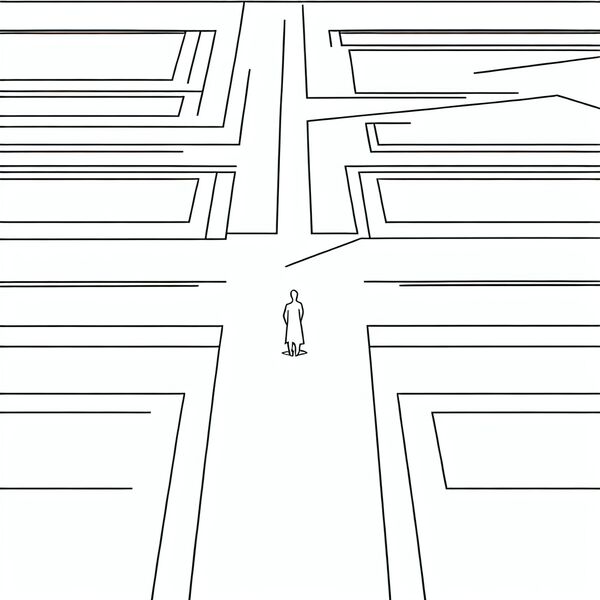
The Absinthe Wing · Modern European
Existentialism
The philosophy that starts when your excuses run out
A man destroyed his own happiness on purpose — handed back the ring to the woman he loved — because he believed he had to choose between love and truth. Kierkegaard chose existence and accidentally built the framework for every 3 AM crisis you've ever had about whether your life is actually yours. No script, no essence, no excuses — just you and the choices that make you.
In 5 minutes
Existentialism says we are not born with a fixed purpose; we create who we are through our free choices and must own them.
- Existence comes before essence: we make ourselves through what we choose.
- Bad faith is pretending we are not free, to avoid responsibility.
- Anxiety can be the "dizziness of freedom", a sign that choices are real.
Try today: Notice one sentence you say like "That’s just who I am". Rewrite it as "So far I have chosen…".
Jump to the practiceBefore you go in…
One small question at the door. No right answers, just yours, and then how Existentialism would reason about it.
You're in a job, a city, or a relationship you mostly drifted into. Nobody is forcing you to stay. When someone asks why you're there, what's true?
Content note: This room discusses death and suicide. If you're struggling, help is here — Tele-MANAS 14416 (India) · findahelpline.com.
You already know something is off. This is the philosophy that explains why — and what to do about it.
A Man Destroys His Own Happiness on Purpose#
Copenhagen, October 11, 1841. A twenty-eight-year-old with wild hair and the eyes of someone who hasn't slept in a week sits across from the woman he loves. He's loved her since she was fifteen. He once described her laugh as having "a halo around her head."
He's about to hand back the ring.
Regine Olsen weeps. She pleads. She threatens to kill herself. Her father gets on his knees and begs. Søren Kierkegaard's heart is shattering — he'll write her name obsessively in his journals for the rest of his life, like a man scratching tally marks on a prison wall — but he does it anyway.
Why?
Because he believes he has to choose: love, or truth. A warm bed and someone to grow old with, or the terrifying, lonely work of figuring out what it actually means to exist.
He chose existence. And in doing so, he accidentally built the philosophical framework for every 3 AM crisis you've ever had about whether your life is actually yours.
This is existentialism. Not a lecture-hall theory but a philosophy born from heartbreak, madness, firing squads, and concentration camps. A philosophy built by a man who hugged a horse and wept, a goalkeeper who won the Nobel Prize, and a chain-smoking couple who blew up every rule about love.
It's also, I think, the only philosophy that's honest enough to be useful. Not because it gives you answers. Because it's the first one that admits there might not be any — and then dares you to live anyway.
Kierkegaard's Magnificent Wound (Or: How Daddy Issues Changed Philosophy)#
You can't understand existentialism without understanding the specific flavor of Kierkegaard's damage. This isn't academic context. This is the wound the whole philosophy bled out of.
Søren's father, Michael Pedersen Kierkegaard, was a wealthy man who carried a secret like a stone in his chest: as a starving boy on the frozen Jutland heath, he'd stood on a hill and cursed God. Screamed at the sky. Told the Almighty to go to hell.
He spent the rest of his life waiting for the punishment. And it came — or seemed to. Five of his seven children died before him. Søren grew up soaking in this atmosphere the way bread soaks in soup: guilt, dread, the sense that being alive was itself a kind of sentence.
Then: a party in 1837. A fifteen-year-old girl named Regine. Lightning strike.
For three years he orbited her — friend, then suitor, then something more desperate. One evening in 1840, while she played piano at her family home, he finally cracked: "Oh! What do I care for music, it's you I want, I have wanted you for two years."
She said yes. Her father gave his blessing. For a few shimmering weeks, Kierkegaard experienced something he'd never known: uncomplicated happiness.
It terrified him.
Not Regine — he adored Regine. What terrified him was himself. "There was something spectral about me," he later wrote, "something no one can endure who has to see me every day and have a real relationship with me." He was too dark, too obsessive, too consumed by questions that had no answers. He believed that marrying her would mean living a lie — performing "husband" like an actor who's forgotten he's on stage.
So he destroyed it. Wrote her cruel letters to make her hate him. Played the villain so she'd grieve anger instead of loss. Called it the most painful thing he ever did.
And then — the remarkable part — he wrote.
Out of that wound poured Either/Or, Fear and Trembling, The Concept of Anxiety, The Sickness Unto Death. Books that grabbed nineteenth-century certainty by the throat and asked the questions polite people don't ask: What does it mean to be a self? Why are we so terrified of our own freedom? What happens when you stop performing your life and actually live it?
Kierkegaard never used the word "existentialism." He died at forty-two, worn out by his own intensity. But everything that followed — Nietzsche, Heidegger, Sartre, Camus, Beauvoir — grew from the soil of his heartbreak.
Existentialism didn't begin with a theory. It began with a man who wrecked his own happiness because he couldn't stop asking why.
Try this right now: Think about one relationship — romantic, professional, whatever — where you're performing a role instead of being honest. You don't have to blow it up (Kierkegaard's approach is... extreme). But name it. Say it out loud, even to an empty room. That small act of honesty is the first existentialist move there is.
The Scream That Became a Movement#
Here's what makes existentialism different from every other philosophy you half-remember from school: it didn't start as a theory. It started as a scream.
Most philosophies begin with a polite question. "What is the nature of reality?" "How should we organize society?" "What can we know for certain?" Existentialism begins with something more like a hand around your throat: "I'm alive. I'm going to die. Nothing comes with instructions. Now what?"
Kierkegaard screamed it in 1840s Copenhagen. Nietzsche screamed it in 1880s Switzerland, half-blind and alone in cheap boarding houses. Dostoevsky screamed it in 1860s St. Petersburg, still shaking from a staged execution. None of them knew each other. None of them planned a movement. They were just people who couldn't stop staring at the terrifying, beautiful, absurd fact of being conscious in a universe that never asked for their opinion.
You've felt this too. Maybe not on a cliff in Switzerland. Maybe it was staring at an empty Google Doc at 2 AM when you were supposed to be writing something that would define your career. Maybe it was scrolling Netflix for forty-five minutes, paralyzed by infinite choice, aware at some level that the paralysis was about something much bigger than what to watch. Maybe it was the morning after a breakup, when the whole architecture of your future collapsed and you realized you'd have to build a new one from scratch, with no blueprints and no guarantee it wouldn't collapse again.
That feeling? That vertigo? The existentialists have a name for it. They call it being awake.
The Big Ideas (Without the Jargon, Without the Lies)#
Existentialism isn't a doctrine. It's more like a family of insights discovered separately by people who were all staring into the same abyss. The common thread: we are free, and that freedom is the most terrifying thing about us.
Here's what they found:
You Showed Up Without a Manual#
Sartre's famous line: "Existence precedes essence." Translation: you weren't born with a purpose. You're building the plane while flying it.
A hammer has an essence before it exists — someone designed it to hit nails. But you? You showed up in the world with no instruction manual, no predetermined nature, no cosmic job description. You're not a hammer. You're not even a Swiss Army knife. You're raw material that has to decide, moment by moment, what to become.
This sounds like freedom. It is freedom. It also feels like standing in an aisle with four hundred varieties of cereal, knowing that your choice matters and also that it shouldn't matter this much, and wanting to scream.
If nothing defines you in advance, then every choice you make is defining you right now. There's no "real you" waiting to be discovered like some archaeological artifact. There's only the you that your choices are building, brick by brick, including the bricks you're laying while pretending you're not choosing.
You picked your career (or you picked not to pick, which is the same thing). You picked your city. You picked to keep reading this instead of doing the thing you're avoiding. All of it is building you.
Freedom Is Not the Fun Kind#
You're free. Not free in the bumper-sticker sense. Free in the way that's closer to vertigo.
Even in a prison cell, you choose how to respond. Even under systems of oppression, you choose your resistance, your attitude, your meaning. Viktor Frankl, the psychiatrist who survived Auschwitz, put it in words that have been resonating since 1946: "Everything can be taken from a man but one thing: the last of the human freedoms — to choose one's attitude in any given set of circumstances."
But here's what nobody puts on the bumper sticker: freedom this radical comes with responsibility this heavy. You can't blame God. You can't blame your parents. You can't blame capitalism, your therapist, Mercury retrograde, or the algorithm. You chose. You always chose. Even choosing not to choose was a choice — probably your most frequent one.
Try this for one week: Every time you say "I have to" or "I can't," replace it with "I choose to" or "I choose not to." "I choose to go to this job." "I choose not to have that conversation." Feel the difference. Feel the weight settle on your shoulders. That weight? That's your life. You've been carrying it the whole time — you just weren't admitting it.
The Dizziness of Being Free#
Existential anxiety — Angst — isn't the kind your doctor medicates (though it might coexist with it). It's the dizziness of standing at the edge of your own freedom and looking down.
Kierkegaard's metaphor is perfect: imagine standing at the edge of a cliff. You're not afraid of falling. You're afraid because you could jump. You have the freedom to do the most terrifying thing imaginable, and nothing but your own choice stands between you and the void.
That's Angst. The awareness of your own radical freedom. The realization that the guardrails you thought were there — society's expectations, your parents' plans, the career track, the life script — were always optional. You were always free to walk off the path. The path was always a suggestion.
Most people spend their entire lives building elaborate structures to avoid this feeling. Routines. Identities. Beliefs they never examine. The entire machinery of "keeping busy" is, at its core, a project to avoid sitting still long enough to feel the dizziness.
The existentialists say: stop running. The anxiety isn't a malfunction. It's your freedom trying to get your attention.
Bad Faith: The Lies You Tell So Well You Believe Them#
"Bad faith" is Sartre's term for the small, constant lies we use to dodge our freedom. And before you think you're exempt — you're not. Neither am I.
Sartre's famous example: a waiter in a café who moves with exaggerated precision, whose gestures are a little too crisp, whose deference is a little too perfect. He's not a person choosing to wait tables. He's become a waiter — he's collapsed his entire identity into a role, and the collapse is a relief, because a waiter doesn't have to face existential freedom. A waiter just serves coffee.
You do this too. "I'm not a creative person." "I'm just not good at relationships." "That's just who I am." Every one of these is a small coffin you've built for yourself — a way of pretending that your personality is a geological formation rather than a series of choices you keep making.
Authenticity, by contrast, is terrifying. It means acknowledging that you are the author of your life, that the pen is in your hand right now, and that every moment you spend pretending your hands are tied is a moment you're choosing to waste.
It doesn't mean being selfish. It doesn't mean "living your truth" in the Instagram-caption sense. It means being honest about the fact that you're choosing — even when the choice is ugly, even when you'd rather not own it.
The Universe Doesn't Care (And That's the Good News)#
Albert Camus gave us the concept of the absurd, and once you see it, you can't unsee it. (A fair warning: Camus himself rejected the "existentialist" label and said so publicly. He's in this room because he's in the same conversation — not because he signed up for the club.)
The absurd is the collision between two facts: (1) we desperately, biologically, existentially need the world to mean something, and (2) the universe has absolutely no opinion on the matter. We want answers. The cosmos delivers silence. We want purpose. The stars are indifferent. We want some sign that our suffering means something, and the sky just keeps being sky.
The absurd isn't a conclusion — it's a starting point. The question isn't "Is life meaningless?" The question is: "Given that the universe isn't going to hand me a meaning — what do I do now?"
Camus's answer is Sisyphus: the mythological king condemned to roll a boulder up a hill for eternity, only to watch it roll back down every time. The task is pointless. The repetition is infinite. And Camus's radical, beautiful, infuriating claim: "One must imagine Sisyphus happy."
Not because the task has meaning. Because Sisyphus chooses to find his own meaning in the doing of it. Because the boulder is his. Because the hill is his. Because in the moment of walking back down to start again, knowing full well how it ends, he is more free than anyone who's never questioned their purpose.
You've got your own boulder. That project at work you keep pushing forward knowing it might get killed. The relationship you keep showing up for with no guarantee it'll last. The creative thing you keep making that nobody reads. That's your hill. Walk back down. Start pushing again. Camus would light a cigarette and nod.
Five Stories That Will Ruin Your Comfortable Afternoon#
Nietzsche Hugs a Horse and Loses His Mind#
January 3, 1889. Turin, Italy. Friedrich Nietzsche — the man who told the world God was dead, who spent a decade alone and half-blind writing books almost nobody read, who called humanity to become something greater — steps out of his boarding house and sees a coachman whipping a horse.
Something inside him detonates.
He runs to the horse, throws his arms around its neck, and sobs. Then he collapses. He will never write another coherent word.
For eleven years, until his death in 1900, Nietzsche existed in a fog of madness — the cause is still debated by scholars. His sister Elisabeth, a woman with Nazi sympathies and no scruples, seized his manuscripts and twisted his ideas into propaganda for an ideology he would have vomited on. The man who wrote "He who fights with monsters should look to it that he himself does not become a monster" became a monster's mascot.
But the image that sticks: the philosopher of the will to power, the great advocate of hardness and self-overcoming, brought to his knees by compassion for a suffering animal. The toughest thinker of the nineteenth century was undone not by an idea but by empathy. By being too human for his own philosophy to hold.
Before the horse, Nietzsche had spent years wandering Europe alone, rejected by Lou Salomé (the only woman he loved — she chose his friend), broken from his mentor Wagner, writing in cheap rooms with failing eyesight. His philosophy of joyful affirmation — amor fati, love your fate, say yes to life even in its cruelest moments — was forged in loneliness and physical agony.
His dare to us, still ringing: "Was that life? Well then — once more!"
The micro-practice Nietzsche earned the right to teach: Next time something hits you hard — rejection, failure, loss — don't immediately reach for your phone or a drink or a distraction. Sit with it for sixty seconds. Then ask yourself Nietzsche's question: "Can I love this? Can I want this to happen again?" You don't have to say yes. But asking the question changes something.
Sartre and Beauvoir Blow Up the Relationship Rulebook#
Paris, 1929. A twenty-one-year-old Simone de Beauvoir sits for the agrégation in philosophy — the most brutal academic exam in France. She comes second. First place goes to a short, wall-eyed, aggressively chain-smoking young man named Jean-Paul Sartre.
They fell in love immediately. They stayed entangled for fifty-one years. But the thing they built together looked like no relationship anyone had seen.
No marriage. No shared apartment (for most of their lives). An explicit deal: theirs was the "necessary" love — the essential thing — but they were both free to pursue "contingent" loves on the side. And they did. Both pursued other relationships — Beauvoir notably with the American novelist Nelson Algren and filmmaker Claude Lanzmann.
Was it perfect? God, no. Beauvoir's diaries drip with jealousy and loneliness that the public myth of their partnership papered over. Sartre could be breathtakingly careless with people. Their arrangement, by all accounts, came with complications.
But here's the thing that matters: they chose it. Every year, they chose it again. They refused to inherit anyone else's template for love. They treated their relationship as an existential project — something to be created, examined, torn apart, and rebuilt. In a world where most people just did what was done, they asked: "But why? What if we didn't? What would we build instead?"
Beauvoir took this further than Sartre ever did. The Second Sex (1949) dropped existentialism's most devastating sentence: "One is not born, but rather becomes, a woman." Essence doesn't precede existence — not even for gender. It was the match that lit modern feminism, and the world is still burning from it.
Camus: From Goalkeeper to Nobel Laureate#
Before Albert Camus was the handsomest philosopher in Paris, before The Stranger, before The Myth of Sisyphus, before the Nobel Prize at forty-four — he was a goalkeeper for Racing Universitaire d'Alger, growing up in crushing poverty in French Algeria, raised by a deaf, illiterate mother in a two-room apartment with no books.
He found philosophy on a football pitch before he ever found it in a classroom.
"What I know most surely about morality and the duty of man, I owe to sport," he wrote. Sounds like a sports cliché until you think about what a goalkeeper actually does: stand alone, face oncoming chaos, make a split-second choice, and live with it. No one to blame if the ball goes in. No one to thank but yourself if you save it. It's existentialism in cleats.
Tuberculosis killed his football career at seventeen. The same disease stalked him for the rest of his life, keeping mortality not as an abstract concept but as a permanent resident in his chest. Every breath was borrowed time, and he knew it, and it shows in every sentence he wrote.
When Camus died in a car crash in 1960, he was forty-six. They found an unused train ticket in his coat pocket. He'd planned to take the train. Changed his mind at the last second. Accepted a ride from his publisher instead.
The absurd, it turns out, wasn't just something Camus wrote about. It was waiting for him on a road in Villeblevin.
Dostoevsky Faces the Firing Squad#
December 22, 1849. St. Petersburg. Fyodor Dostoevsky and several other political dissidents are marched into Semyonov Square. White execution robes. Stakes. Rifles raised.
A messenger arrives. Commutation from the Tsar. The whole thing was theater — psychological torture designed to break them.
It worked on some. One man went permanently insane on the spot. But Dostoevsky came out of it changed. Four years in a Siberian prison camp followed, and for the rest of his life he wrote with the scalding intensity of a man who had tasted death and found life unbearably, piercingly sweet.
"The mystery of human existence lies not in just staying alive, but in finding something to live for."
Every word Dostoevsky wrote after that morning carries an electric charge — the charge of someone who knew, in his body and not just his head, that existence is not guaranteed. That every moment you get is stolen from the void.
A practice you probably need: Write your own eulogy. Not the aspirational one — the honest one. What would people actually say if you died this afternoon? Now look at the gap between that eulogy and the one you want. That gap is your existential to-do list. It's probably shorter than you think. And you probably already know what's on it.
Frankl in the Camps#
Viktor Frankl was a Viennese psychiatrist who'd already been developing his "logotherapy" — therapy through meaning — when the Nazis deported him to Auschwitz in 1944. His pregnant wife, his parents, his brother: killed. His manuscript — his life's work, sewn into his coat lining — confiscated and destroyed.
He survived. And in the camps, he observed something that confirmed everything existentialism had been arguing: the prisoners who lasted were not the strongest or healthiest. They were the ones who had something to live for. A child waiting. A book to write. A person to see again.
"He who has a why to live can bear almost any how," he wrote, borrowing from Nietzsche. His book Man's Search for Meaning — written in nine days after liberation — sold sixteen million copies and brought existentialist ideas to people who'd never heard of Kierkegaard. It's the kind of book that changes what you do the morning after you finish it.
"But Isn't It Depressing?" (No. Sit Down.)#
This is the most common thing people say about existentialism, and it drives me up a wall.
Yes, it starts with hard truths. No inherent meaning. You're going to die. You're radically alone in your own skull. But existentialism doesn't stop there — that's nihilism's neighborhood, and existentialism just passes through on the way to somewhere better.
The whole point is what comes after the hard truths:
There's no inherent meaning — so you're free to make your own. There's no predetermined essence — so you can become anything. You're going to die — so this moment actually matters.
Camus didn't say "Life is absurd, so give up." He said "Life is absurd — so swim in the sea." Kierkegaard didn't say anxiety is a curse. He said it's "the dizziness of freedom" — a door, not a wall. Nietzsche didn't say "God is dead, so nothing matters." He said "God is dead — so everything matters, because nobody's coming to handle it for you."
Existentialism is not the philosophy of despair. It's the philosophy of radical hope — hope that doesn't need a guarantee, hope that persists because there's no safety net. It's the hope of someone who's looked into the void and decided to build a garden anyway.
As Sartre put it: "Life begins on the other side of despair."
If that's depressing, you're reading it wrong.
The Camus practice: Do one thing today that has no purpose whatsoever except joy. Swim. Eat something incredible. Sit in the sun until you feel like a lizard. Play a stupid game. This isn't escapism. This is existentialist resistance — a refusal to let life justify itself before it's allowed to be beautiful.
Existentialism at 3 AM: Why This Philosophy Won't Leave You Alone#
Browse any philosophy subreddit and you'll find people stumbling into existentialism the same way Kierkegaard did: through crisis.
"I just realized nothing I do matters and I'm freaking out," someone posts at 3 AM. And then, always, someone replies: "You're not freaking out. You're waking up. Read Camus."
People find existentialism when the frameworks collapse. A layoff. A breakup. A diagnosis. A pandemic that locks you in a room with nothing but your own thoughts and an internet connection that only makes the silence louder. The moment when the story you've been telling yourself about your life stops making sense, and you're left standing in the rubble wondering who you actually are without it.
Existential therapy — built by practitioners like Rollo May, Irvin Yalom, and Emmy van Deurzen — takes this seriously. It doesn't try to "fix" you. It doesn't treat your anxiety as a chemical glitch to be medicated away. It treats your dread as information. You're not broken. You're confronting what Yalom calls the four "ultimate concerns" of being human:
- Death: you will end.
- Freedom: there's no external structure holding your life together.
- Isolation: no one can fully enter your experience.
- Meaninglessness: there's no obvious point to any of this.
Existential therapy doesn't try to make these go away (they can't — they're baked into the operating system). It helps you face them, engage with them, and build a life that includes them instead of running from them. It's therapy for people who are tired of being told to think positive and want someone to tell them the truth instead.
And the truth, it turns out, is more livable than the lies.
Living It: Daily Practices That Actually Work#
You don't adopt existentialism like you'd adopt a diet. You practice it the way you'd practice an instrument — badly at first, then less badly, with occasional moments of something that sounds like music.
The Morning Audit (Five Minutes, Before Your Phone)#
Three questions. Every morning. Before the world rushes in:
- Am I living today, or performing today? Is this day mine, or am I running someone else's script?
- What am I avoiding? Not the tasks — the truths. What conversation, what decision, what reality am I pretending doesn't exist?
- If today were the last one, would I spend it like this?
You won't always like the answers. That's the point.
The Kierkegaard Walk#
Kierkegaard walked Copenhagen's streets for hours every day. No headphones (obviously). No destination. No podcast. Just walking and thinking and letting the uncomfortable thoughts have their say.
Do this. Twenty minutes, minimum. Leave your phone at home if you can stand it. Let boredom arrive — and then keep walking past it. The interesting stuff lives on the other side of boredom.
The Evening Reckoning (Five Minutes)#
One question: "Did I choose today, or did today choose me?"
No judgment. Just observation. Over weeks, the ratio shifts. That shift is the entire existentialist project in miniature.
Words That Will Stay in Your Chest#
"Life can only be understood backwards; but it must be lived forwards."#
— Kierkegaard, Journals (1844)
He wrote this while still reeling from Regine. Trying to understand why he'd wrecked his own happiness — and realizing the understanding would only come later. Maybe. In the meantime, he had to keep going. We all do.
"Man is condemned to be free; because once thrown into the world, he is responsible for everything he does."#
— Sartre, Existentialism Is a Humanism (lecture 1945, published 1946)
Spoken in a packed Paris lecture hall just months after the Nazi occupation ended. Sartre had lived through years when freedom wasn't a metaphor — it was a matter of life and death. (He worked out the deeper theory earlier, in Being and Nothingness, 1943.)
"One must imagine Sisyphus happy."#
— Camus, The Myth of Sisyphus (1942)
The last line of a book he wrote at twenty-eight, while France was collapsing and his lungs were failing from tuberculosis. It's not optimism. It's something harder and more beautiful than optimism. It's defiance.
"Anxiety is the dizziness of freedom."#
— Kierkegaard, The Concept of Anxiety (1844)
The most beautiful reframing in the history of thought. Your anxiety isn't a disorder. It's a signal. It means you're standing at the edge of your freedom and looking down.
"One is not born, but rather becomes, a woman."#
— Beauvoir, The Second Sex (1949)
The sentence that detonated modern feminism. Beauvoir took Sartre's "existence precedes essence" and applied it to gender. The blast radius is still expanding.
"God is dead. God remains dead. And we have killed him."#
— Nietzsche, The Gay Science (1882)
Everyone misreads this as a victory lap. It's not. It's spoken by a madman in a marketplace, and it's spoken with horror. Nietzsche wasn't celebrating. He was warning: without God, you have to create your own values. And most people would rather die than do that.
"The only way to deal with an unfree world is to become so absolutely free that your very existence is an act of rebellion."#
— Camus, The Rebel (1951)
"The most common form of despair is not being who you are."#
— Kierkegaard, The Sickness Unto Death (1849)
Not violating some divine law. Not breaking a commandment. The worst thing you can do to your soul is live someone else's life. And you're probably doing it right now, in at least one area. You know which one.
"In the midst of winter, I found there was, within me, an invincible summer."#
— Camus, Return to Tipasa (1954)
He wrote this after revisiting the Algerian ruins where he'd been happy as a young man. They were fenced off, colonized, changed. But the feeling — of being alive, free, in love with the world — hadn't gone anywhere. It was inside him. It always had been.
"Between stimulus and response there is a space. In that space is our freedom."#
— Often attributed to Viktor Frankl
The entire existentialist insight compressed into one sentence you can carry in your pocket.
"Every existing thing is born without reason, prolongs itself out of weakness, and dies by chance."#
— Sartre, Nausea (1938)
Bleak? Sure. But flip it: if existence has no built-in reason, then you supply one. The bleakness is the beginning of your authority.
Where to Start Reading (A Honest Path)#
Start with Camus's The Myth of Sisyphus. It's 120 pages. It opens with the sentence "There is but one truly serious philosophical problem, and that is suicide" and then proceeds to make the most compelling argument for living you'll ever encounter. Read it on a sunny day, near water if possible.
Then Man's Search for Meaning by Frankl. The most accessible door into existentialist ideas. You'll read it in a day and think about it for years.
Then Sartre's Existentialism Is a Humanism. A short lecture, published as a pamphlet. The clearest, most direct statement of existentialist principles that exists. Written for humans, not academics. Free online.
Then Camus's The Stranger. A novel so spare it reads like a slap. Meursault refuses to perform emotions he doesn't feel, and society kills him for it. You'll finish it in an afternoon and stare at the wall for an hour.
Then Kierkegaard's Fear and Trembling. Written in the white heat of losing Regine. Poetic, anguished, and unforgettable. It will make faith feel dangerous again, which is probably what faith is supposed to feel like.
Then Beauvoir's The Second Sex. Not quick, but transformative. At minimum, read the introduction and "The Independent Woman." It will change how you see every room you walk into.
And if you want one book about existentialism: William Barrett's Irrational Man. The best overview written, by someone who actually understands why these ideas feel urgent instead of academic.
The Family Tree: Who Existentialism Drinks With#
Absurdism is existentialism's younger sibling who showed up to Thanksgiving with a flask. Where existentialism says "create your own meaning," absurdism (Camus's contribution) says "meaning-creation itself might be futile — do it anyway, and laugh while you do." The difference is one drink and a sense of humor.
Nihilism is the problem; existentialism is the response. Nietzsche saw nihilism coming — the collapse of all values after God's death — and existentialism was the attempt to survive the collapse without falling into the hole. Nihilism says "nothing matters." Existentialism says "nothing matters inherently — which means what you do matters infinitely."
Stoicism is the surprising cousin. Both emphasize what's in your control versus what isn't. Both demand you face hard truths without blinking. The difference: Stoicism trusts in a rational cosmic order. Existentialism trusts nothing but your own freedom. Stoicism is existentialism with a safety net. Existentialism is Stoicism without one.
Buddhism is the unexpected pen pal. Both start with suffering. Both argue that attachment to fixed identities causes pain. Both prefer direct experience over abstract theory. The Buddhist concept of anatta (no-self) rhymes with existentialism's rejection of fixed human essence. They've been saying similar things from opposite ends of the earth for centuries.
Phenomenology is the academic parent. Husserl, Heidegger, Merleau-Ponty. Where existentialism asks "How should I live?", phenomenology asks "What is the structure of lived experience?" Heidegger's Being and Time is both traditions at once. Most philosophers refuse to untangle them.
Your First Week (No Excuses Edition)#
Day 1: Read the last chapter of The Myth of Sisyphus — just the chapter called "The Myth of Sisyphus." Ten pages. It will rearrange something in your brain that needed rearranging.
Day 2: Walk for twenty minutes without your phone. Notice what shows up when there's nowhere to scroll. Don't judge it. Just notice.
Day 3: Write down three things you do because you "have to." Then be honest: do you have to, or do you choose to? What would actually happen if you stopped?
Day 4: Read Sartre's Existentialism Is a Humanism. Free online. One hour. Worth more than most therapy sessions.
Day 5: Have a conversation about death with someone you care about. Not morbidly. Honestly. What are you afraid of? What do you want to do before it happens? Why haven't you?
Day 6: Do the thing you've been avoiding because you're afraid of failing. Remember: the fear is the dizziness of freedom. It means you're standing at the edge of something real.
Day 7: Go outside. Watch the sky. Don't try to find meaning in it. Just watch. If you feel a strange mix of terror and peace — congratulations. That's what Kierkegaard felt. That's what Camus felt staring at the Mediterranean. That's what it feels like to be a human being who knows they're a human being.
There are no answers here. There were never going to be. Existentialism doesn't sell you a destination. It hands you the fact of your freedom like a lit match and says: your move.
What you build with it — the relationships you choose, the work you pour yourself into, the moments you refuse to let pass without noticing — that's yours. No one else's. No philosophy can give it to you. No philosophy should.
Somewhere in Copenhagen, a man with wild hair and sad eyes is walking through the streets alone, thinking about a woman he loved too much to lie to. Somewhere in Algeria, a goalkeeper with bad lungs is staring at the sea, feeling the sun on his face, choosing to call it enough. Somewhere in Turin, a philosopher has his arms around a horse's neck, weeping, because the world is too beautiful and too cruel to bear with a dry eye.
And somewhere — right now, in the specific, unrepeatable moment of your life — you're reading this. You felt something. You're going to close this page and go back to your life.
The only question existentialism asks is: which life?
The one you've been performing? Or the one that's actually yours?
"In the midst of winter, I found there was, within me, an invincible summer." — Albert Camus
Find yours.
Talk about it · 4 questions
- What does "existence precedes essence" mean? Give an example from your life.
- Why did Kierkegaard break off his engagement, and what did it teach him?
- Camus rejected the label "existentialist". Why might he still belong in this room?
- How did Simone de Beauvoir use existentialist ideas to think about women’s lives?